 Vincere
The moment hits you. Maybe it's after you snapped at someone you love, or when you scroll past a peer's incredible achievement, or perhaps you're just staring at the neglected project on your desk, knowing you promised yourself you'd finish it weeks ago. A cold knot forms in your stomach, your shoulders slump, and a voice inside whispers, "You are a mess. You should be ashamed of yourself."
It's not just embarrassment, which passes quickly. It's deeper. It's the feeling that there's something fundamentally wrong with you, not just with what you did. It's the quiet conviction that you are unworthy, exposed, and fundamentally flawed. If you're reading this, chances are you've asked yourself, "Why am I ashamed of myself?" and desperately want to know what to do when you feel ashamed of yourself.
You're not alone in feeling this. Shame is a universal human experience, and it can feel incredibly isolating. But you don't have to stay stuck in that feeling. There are practical, kind steps you can take today to loosen its grip and start moving forward.
Understanding the Heavy Blanket of Shame
First, let's untangle shame from guilt. Guilt says, "I did something bad." Shame says, "I am bad." Guilt can be a helpful guide, prompting you to apologize or make amends. Shame, on the other hand, often leads to hiding, withdrawal, and self-sabotage. It feeds on secrecy and comparison.
Why does it hit so hard? Often, shame stems from: * The Inner Critic: That relentless voice telling you you're not good enough, smart enough, or disciplined enough. It’s often a replaying of old criticisms or impossibly high standards. * Perfectionism: The belief that anything less than flawless is failure. When you fall short (as all humans do), shame rushes in. * Comparison Traps: Seeing someone else's highlight reel and comparing it to your own messy, imperfect behind-the-scenes. (Comparing Yourself to Others: How to Stop the Quiet Spiral) * Broken Expectations: When you didn't live up to your own values or promises, even if no one else knows.
The tricky thing about shame is that it makes you want to hide, to shrink, to disappear. But hiding only gives it more power.
Feeling stuck in the grip of shame? Take one tiny, courageous step today by adding your first habit to Vincere and share it with a friend.
Try Vincere free Scan with
your iPhone
What Doesn't Work (And What Does)
Trying to ignore shame, numb it, or simply "think positively" rarely works. It's like trying to push a beach ball underwater; it just pops back up with more force. Self-flagellation—beating yourself up further—only reinforces the inner critic's message.
So, what does work? Small, courageous, and deeply human steps.
Step 1: Name It to Tame It
The first act of courage is to simply acknowledge the feeling. Don't judge it; just label it. * "I feel ashamed of myself right now because..." * "This feeling in my chest is shame."
Naming it reduces its amorphous power. It separates you from the feeling, making it something you experience rather than something you are.
Step 2: Shift from Judgment to Curiosity
Instead of "Why am I so pathetic?", try "What is this feeling trying to tell me?" * What triggered this specific wave of shame? * What underlying belief is it tied to? (e.g., "I'm not productive enough," "I'm not a good friend," "I'll never succeed.") * Is that belief truly, 100% accurate? Often, you’ll find it’s an all-or-nothing distortion.
This isn't about excusing your actions (if there were any). It's about understanding the root cause of the emotional pain, so you can address it, not just suffer through it.
Step 3: Choose One Tiny Action (Today)
Shame thrives on paralysis. It tells you, "It's too big, you're too messed up, why even try?" The antidote is tiny, doable action. Don't aim to fix everything. Aim to make one tiny move in the right direction.
- If you snapped at someone: Send a short text, "Hey, I'm sorry about earlier. That wasn't fair of me."
- If you're behind on a project: Open the document. Read the last paragraph. Write one sentence. (Even just "Title:" is a win.)
- If you skipped a workout: Don't promise to run a marathon tomorrow. Just put on your walking shoes and walk to the mailbox.
- If you ate something you "shouldn't have": Drink a glass of water. Prep a simple, healthy meal for your next eating occasion.
The goal isn't perfection; it's momentum. It's proving to yourself that you can make a choice different from the one that led to the shame. Even a microscopic step is a win.
Step 4: Practice Radical Self-Compassion
This is often the hardest, but most important step. Talk to yourself as you would a dear friend who came to you with this exact feeling. Would you say, "You're a failure! You should have known better!"? No. You'd offer kindness, understanding, and practical support.
- "It's okay to feel this. It's a tough emotion."
- "This doesn't make you a bad person. It makes you human."
- "What's one small thing you can do to be kind to yourself right now?"
Remember, shame feeds on self-criticism. Self-compassion starves it.
Step 5: Break the Silence – Share Your Effort (Not Just Your Shame)
Shame loves isolation. It wants you to believe you're the only one who struggles. But human connection, even a small, supportive one, can be its undoing. You don't have to pour out your deepest shame to everyone, but sharing your effort – your small, courageous steps – can be incredibly powerful.
This is where a little accountability can make a huge difference. Think about sharing one of those tiny actions from Step 3 with a trusted friend. Tell them, "I'm going to do X today, even though I'm feeling ashamed about Y." Even better if they can see your effort.
Maybe you decide to tackle that neglected project. You can add it as a task, check it off, and even add a photo of your one sentence as "proof" – shared just with your chosen accountability crew. Seeing that "W" (win) for showing up, even imperfectly, can be a potent counter to the shame that says you're not enough. (Hate Myself for Procrastinating? The Shame Spiral & Your Way Out)
Combat isolation and shame by sharing your effort, not just your struggles. Invite a friend to Vincere and build a small habit together.
Get Vincere on the App StoreScan withyour iPhone
Building Back, One Small Win at a Time
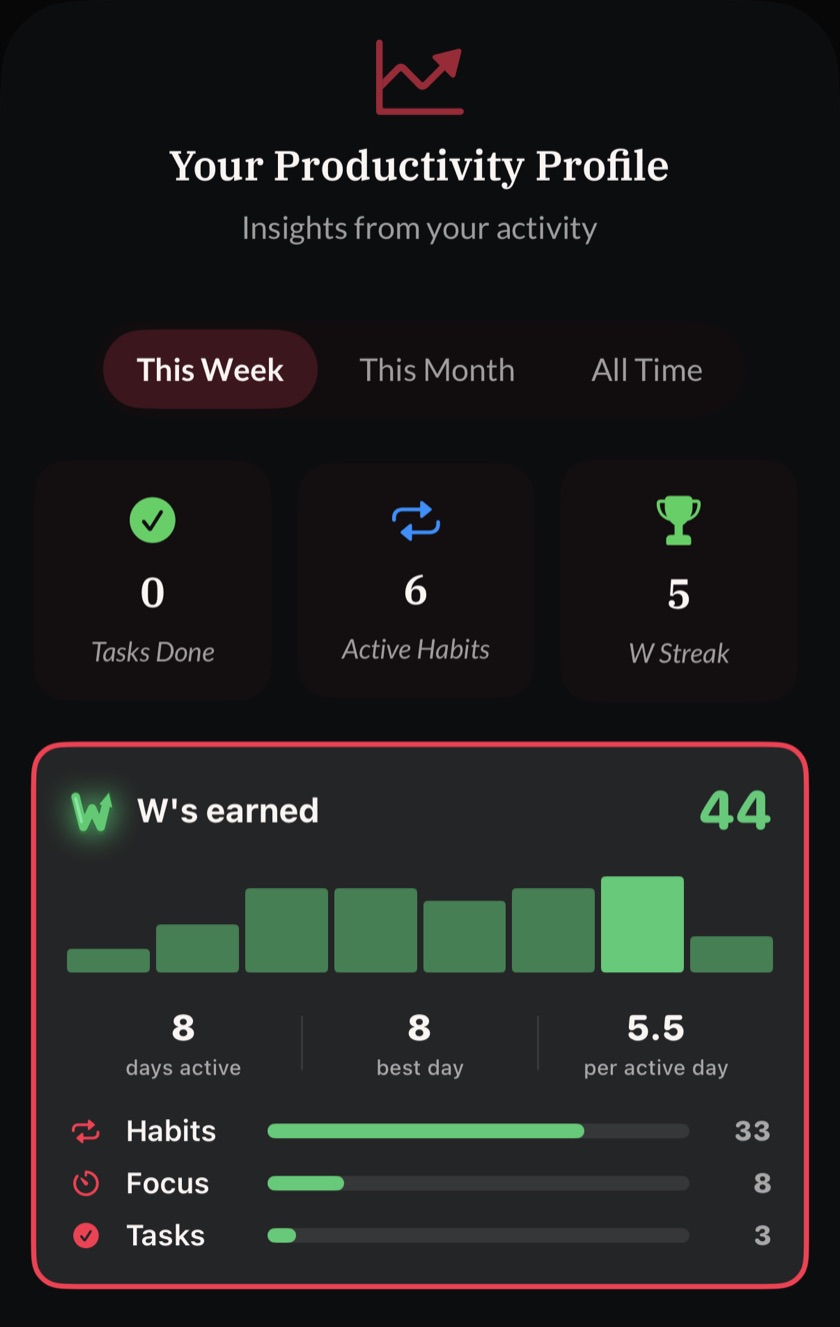
Overcoming deep-seated shame isn't a one-time fix. It's a practice of consistent, gentle effort. * Build tiny habits: Start with habits so small you can't fail. A 2-minute clean-up, one page read, 5 push-ups. Vincere, a free iPhone app, can help you track these and share them with a small crew of friends. You check off your wins, and your crew sees you show up. You can even add a photo of your progress (private by default, or shared with your crew), earning double the credit. * Learn from "L's": When you miss a day or fall short, shame might creep back. Instead of dwelling, look at it as data. What made it hard? How can you adjust tomorrow? Every "L" on your calendar is just a chance to learn, not a condemnation. * Focus on progress, not perfection: Your "Productivity Profile" in Vincere shows your streak, your wins, and your consistency. It's a visual reminder of how far you've come, even with bumps in the road.
If shame feels overwhelming, if it's impacting your daily life, or if you find yourself unable to move forward, please remember that you don't have to carry this alone. Reaching out to a doctor, therapist, or local crisis line is a brave and important step. They can provide tools and support tailored to your unique situation.
Ultimately, navigating shame is about cultivating self-compassion and demonstrating to yourself, through small, consistent actions, that you are capable, resilient, and worthy of kindness—especially your own. Start with one small step today.