 Vincere
The gym bag sits by the door, unzipped. Your friend just posted about their latest achievement, and a familiar knot tightens in your stomach. You wanted to start that project today, to make that call, to tackle that habit you keep putting off. But then the quiet whispers started: You'll probably mess it up. What's the point? Everyone else is so much further along. You're just not built for this.
That insidious, draining feeling? That’s self-doubt, and it’s a heavy anchor in a world that demands you set sail. It keeps you stuck, not because you lack ability, but because it convinces you you do.
What is Self-Doubt, Really?
At its core, self-doubt is that gnawing uncertainty about your own abilities, decisions, or worth. It's the inner critic turned up to eleven, second-guessing every move and projecting future failures onto present possibilities.
In psychology, it’s often understood as a form of cognitive distortion, where your thoughts become biased towards negative self-assessment. It’s not just a fleeting worry; it's a pervasive feeling that chips away at your confidence, making even the simplest steps feel insurmountable. It often feeds on perfectionism, the fear of judgment, and past perceived failures, twisting them into a narrative of inadequacy.
It’s the silent force that keeps brilliant ideas from ever leaving your notebook, keeps you from applying for that dream job, or even just from starting a simple daily habit. It tells you that the effort isn't worth it, that you're not capable, and that you're better off staying safe and small.
Feeling stuck by self-doubt? Start with one tiny step today by adding a new habit in Vincere and sharing it with a friend.
Try Vincere free Scan with
your iPhone
Why Does Self-Doubt Feel So Stubborn?
You’re not alone in feeling this way. Self-doubt is a universal human experience, but it feels intensely personal. Here’s why it clings so tightly:
The Inner Critic's Loud Megaphone
You know that voice. It's swift, cutting, and seemingly always right. It points out every past mistake, every perceived flaw, and amplifies them until they drown out any encouraging thoughts. This isn’t usually your voice; it’s often an internalized collection of critical messages from childhood, media, or even well-meaning but misguided advice.
The Comparison Trap (Without the Feed)
Even without endlessly scrolling through highlight reels, we compare our messy insides to everyone else's polished outsides. When someone shares their success, it's easy to look at your own journey – with all its restarts and struggles – and feel like you're falling behind. You see their "W" (win), but you don’t see their "L" (loss) or the effort it took them to get there.
The All-or-Nothing Mindset
Self-doubt loves to paint everything in black and white. If you can’t do something perfectly, why do it at all? This mindset paralyzes you, making you believe that anything less than flawless execution is a catastrophic failure. It stops you from taking the crucial first tiny step.
Fear of Failure (and Success)
This one's tricky. You fear failure because it confirms the inner critic's warnings. But you might also subconsciously fear success because it brings new responsibilities, higher expectations, and a brighter spotlight – all of which can trigger more self-doubt.
Quieting the Whispers: Your Action Plan for Today
The good news? Self-doubt is a pattern, and patterns can be rewritten. You can't just wish it away, but you can consistently take small, defiant actions that gradually weaken its grip.
1. Name It to Tame It
The next time that wave of doubt washes over you, pause. Don't immediately succumb. Instead, identify it. "Ah, there's my self-doubt again, telling me I can't do this." Acknowledging it creates a tiny bit of distance between you and the feeling, allowing you to observe it rather than being consumed by it. Say it out loud if you can. It sounds silly, but it works.
2. Shrink the Task Until It Feels Ridiculous
Self-doubt thrives on overwhelming goals. If your goal is "run a marathon," the doubt will scream. But if your goal is "put on running shoes," it’s much quieter. Break down whatever you’re doubting yourself on into the smallest possible step. * Instead of "write the whole report," try "open the document." * Instead of "clean the entire house," try "put one item away." * Instead of "learn a new skill," try "spend 5 minutes reading about it."
This isn't about achieving a huge outcome; it’s about building a micro-win, a tiny proof point that you can start.
3. Seek Tiny Wins, Not Grand Victories
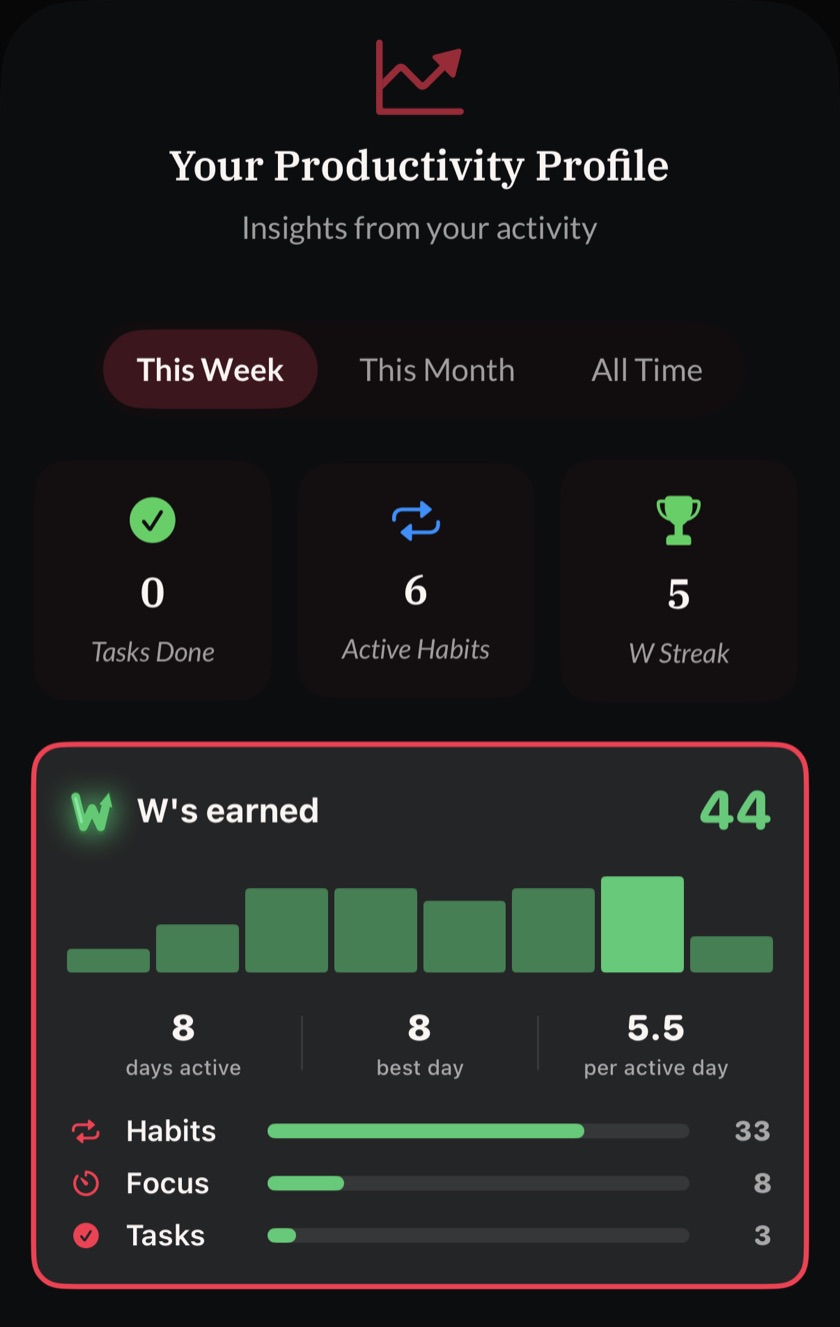
Self-doubt feeds on the gap between where you are and where you think you should be. To bridge that gap, celebrate every single small action you take. Did you put on those running shoes? That's a win (a "W"!). Did you open the document? Another W. Even if you didn't run or write, you showed up. Vincere is designed around this idea – earning a W just for checking off a task, and two W's if you add proof. It reframes showing up as the victory, not just the outcome.
4. Challenge Your Inner Critic: "Is This True, Or Just a Story?"
When your inner critic starts its monologue, ask yourself: * "Is there any actual evidence for this belief, or is it just a feeling?" * "What would I tell a friend who was thinking this?" * "What's the kindest interpretation of this situation?"
Often, you'll find the critic's arguments are based on assumptions, not facts. You can't always silence it, but you can question its authority.
5. Cultivate a "Just Show Up" Mentality
One of the most powerful antidotes to self-doubt is the simple act of showing up, even when you don't feel like it. The feeling of readiness often follows the action, not the other way around. If you commit to showing up for a habit or task, even for just a few minutes, you start building a habit of action over inaction. When you share tasks or habits with friends on Vincere, you create a gentle circle of accountability. Your crew sees that you showed up (or didn't), and that shared transparency can be a powerful motivator to just get started, even when doubt whispers loudest. Knowing someone else sees your effort can make all the difference.
6. Focus on Effort, Not Just Outcomes
Self-doubt loves to focus on results, especially negative ones. Shift your attention to the effort you put in. Did you try your best today? Did you learn something? Did you simply show up and give it a shot? That’s what truly matters for growth. An L (missed day) on a habit tracker isn't a declaration of failure; it's just data. You showed up, or you didn't. The next day is a new chance to earn a W.
7. Seek Support (and Share Your Proof)
Isolation magnifies self-doubt. When you're struggling alone, the whispers can become deafening. Connecting with others who are also striving – even if they're pursuing different goals – can be incredibly powerful. On Vincere, you can share a habit or task with a small, trusted crew. They see your progress, not your entire life. You can even choose to share a photo of your proof (e.g., your packed gym bag, your messy desk after a productive session) – privately, just with your crew, or even just for yourself. This simple act of externalizing your effort can be a huge boost. It’s not about comparison; it’s about shared experience and gentle accountability.
If your self-doubt is overwhelming, paralyzing, or significantly impacting your daily life, please know that you don't have to carry this burden alone. Reaching out to a mental health professional, therapist, or a local crisis line can provide you with dedicated tools and support.
Quiet the inner critic by celebrating every small win. Track your progress and earn W's for showing up with Vincere.
Get Vincere on the App StoreScan withyour iPhone
Your Next Tiny Step
Self-doubt isn't overcome in one grand battle, but in countless tiny skirmishes won by choosing action over inaction, presence over paralysis. It's about building a track record of showing up for yourself, even when you don't feel like it. Start with one incredibly small step today. Put on those shoes. Open that document. Send that email. Every W you earn, no matter how small, is a quiet defiance against the whispers of doubt.