 Vincere
The gym bag sits by the door, unzipped. Your calendar has three tasks highlighted in angry red, but your brain feels like it's wading through thick syrup. You know you should do something, anything, but the couch cushion has somehow fused with your soul. Another day slips by, leaving behind a familiar ache of disappointment, and the quiet whisper, "Why do I feel lazy all the time?"
It's a heavy feeling, isn't it? That internal resistance, the mental fog, the sheer effort it takes to even think about starting something. And if you're experiencing this, you're not alone. Many of us grapple with this sense of inertia, especially when life throws curveballs – whether you're feeling lazy and tired from burnout, navigating the unique demands of pregnancy or a period, or simply staring at a daunting to-do list at work.
Here's the honest truth: "Laziness" is rarely a true character flaw. More often, it's a symptom. A signal from your body or mind that something else is going on. It might be exhaustion, overwhelm, fear, lack of clarity, or even boredom. And understanding which signal it is, is your first powerful step out of the quicksand.
Let's turn that heavy feeling into a lighter, more actionable path, starting right now.
1. What's Your Laziness Really Trying to Tell You?
Instead of beating yourself up, try a moment of gentle curiosity. When you ask yourself, "Why do I feel lazy and weak?" the answer might surprise you. Your brain isn't trying to sabotage you; it's trying to protect you.
- Are you genuinely tired? This is the biggest culprit. Not just physically, but mentally or emotionally exhausted from decision fatigue, constant stress, or too much screen time. Sometimes, "feeling lazy" is just your body screaming for rest.
- Are you overwhelmed? Is the task so big it feels impossible to start? Do you have too many things on your plate? This can trigger an all-or-nothing response where doing nothing feels safer than failing to do it perfectly. (If this sounds familiar, you might find our article, Staring at Everything, Doing Nothing: When You're Overwhelmed and Don't Know Where to Start, helpful.)
- Is there fear involved? Fear of failure, fear of judgment, fear of success even. If the stakes feel high, your brain might choose inertia as a way to avoid potential pain.
- Is it boredom or lack of interest? Sometimes, we're "lazy" because the task genuinely doesn't excite us, or we don't see the purpose behind it.
- Are there physiological factors? For some, "feeling lazy during pregnancy" or "feeling lazy during period" are very real, hormonally-driven experiences that demand more rest and self-compassion. If you suspect an underlying health issue, a quick check-in with your doctor is always a good idea.
Your Mini-Action for Today: Take 60 seconds to do a quick internal scan. What's the loudest reason your body or mind is resisting right now? Don't judge it, just acknowledge it.
Feeling stuck in a rut? Let Vincere help you make that first micro-move today and celebrate every small win.
Try Vincere free Scan with
your iPhone
2. The Micro-Move: Your Secret Weapon Against Inertia
Once you've identified the why, it's time for the how. And the "how" isn't about finding sudden bursts of motivation; it's about making the barrier to entry so absurdly low that you can't not do it. This is the "two-minute rule" in action, or what we call a "micro-move."
Imagine you're feeling lazy to go to the gym. Don't aim to go to the gym. Aim to: * Put on one sock. * Pick up your gym bag. * Open the door.
For feeling lazy at work: * Open the document. * Read the first sentence of the email. * Write one bullet point for your report.
The goal isn't to complete the task. The goal is to start the motion. Often, the hardest part is the initiation. Once you're moving, even just a tiny bit, momentum takes over. It's like pushing a heavy box – the first inch is the hardest, but then it gets easier.
Your Mini-Action for Today: Pick one task you're feeling lazy about. Identify the absolute smallest, most trivial micro-move associated with it. Do only that. If you want to stop after that, that's okay. You still won.
3. Chunk Down the Monster Task
Sometimes, the feeling of "being lazy" is actually overwhelm disguised. If you're staring at a huge project, your brain understandably freezes. It's too much.
Instead of seeing "Write a 10-page report," see: * Open blank document. * Create a title page. * Write down 3 main headings. * Find one source.
Break down any daunting task into its smallest, most digestible components. Each small component then becomes a potential "micro-move" from step 2. This makes it less about "overcoming laziness" and more about "navigating a clear path."
Your Mini-Action for Today: Take one overwhelming task from your to-do list. Spend 5 minutes breaking it into at least 5 smaller, independent steps. You don't have to do them, just list them.
4. Find a Crew: Shrink the Feeling in Shared Effort
One of the sneakiest things about feeling lazy is how isolating it can be. We often feel ashamed, believing we're the only one struggling. This shame keeps us quiet, which in turn amplifies the feeling. But what if you didn't have to carry that weight alone?
Sharing your intentions with even one kind, supportive person can be a game-changer. It's not about being judged; it's about honest, gentle accountability. Knowing someone else sees your effort (or lack thereof) can provide just enough external push to make that micro-move.
Imagine sharing your goal to "walk 10 minutes today" with a friend. Even if you only manage 5, the fact that you showed up, that you put in the effort, is a win. And a kind word from that friend – "Hey, great job getting out there!" – can be more powerful than any self-talk.
Your Mini-Action for Today: Think of one small habit or task you want to tackle. Share it with one trusted friend, partner, or colleague. Simply tell them, "I'm going to try to do [tiny task] today." No pressure, just an open declaration.
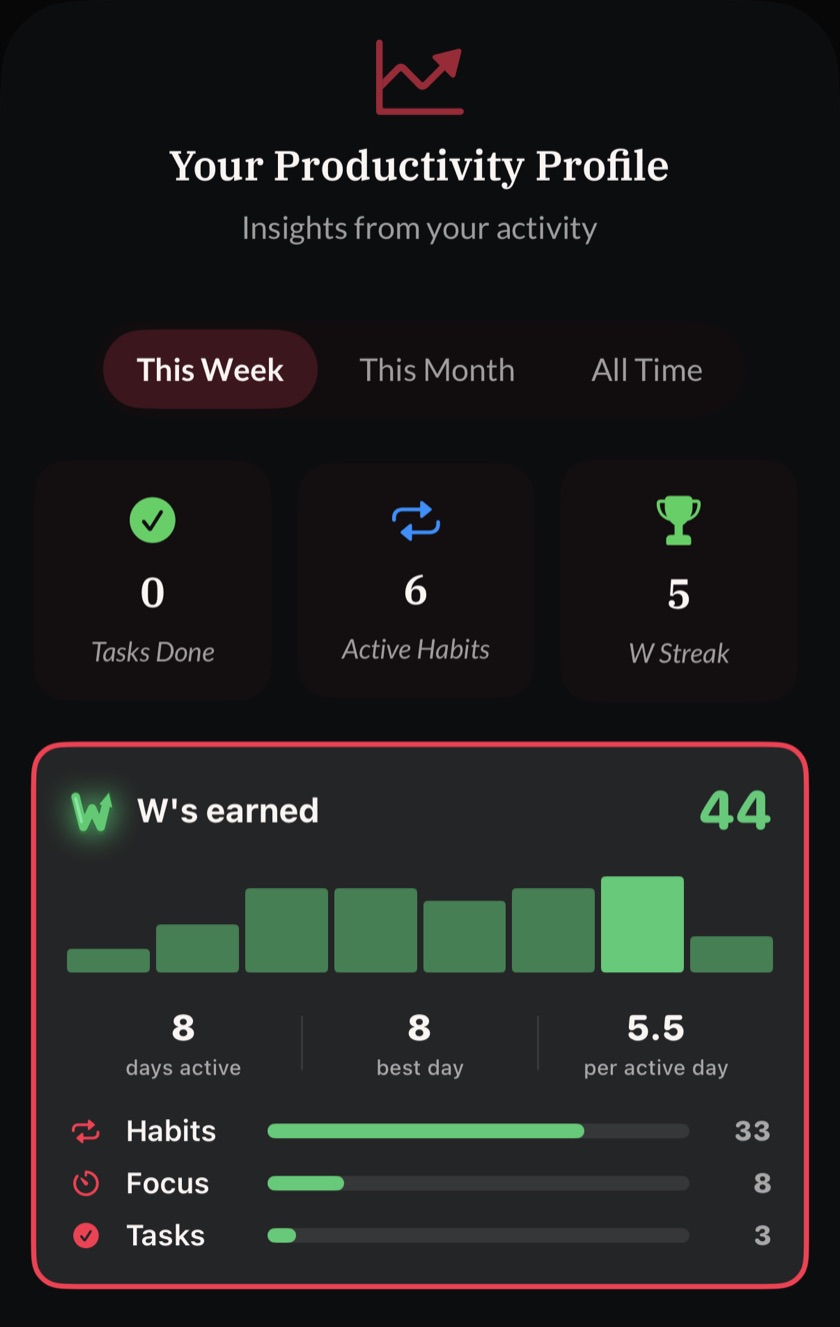
This is where a tool like Vincere can genuinely help. It's a free iPhone app designed to help you build habits with a crew. You can share tasks and habits with friends, and everyone sees who showed up today. When you check off a task, you earn a 'W' (a win!), and adding a photo of proof gives you 2 W's. It's a simple, non-judgmental way to bring the power of shared effort into your daily routine, transforming isolation into shared momentum.
Bring a friend into the journey! Share a small habit or task on Vincere and see how shared effort makes all the difference.
Get Vincere on the App StoreScan withyour iPhone
5. Prioritize Rest and Recovery (Yes, Really!)
If your laziness stems from genuine tiredness, no amount of pushing will truly fix it. You can't pour from an empty cup. Sometimes the most productive thing you can do is rest. This isn't just sleep; it's also active recovery: * True Breaks: Step away from screens. * Mindfulness: Even 5 minutes of quiet contemplation. * Nature: A walk in a park. * Nourishment: Healthy food, enough water.
Ignoring your body's need for rest only compounds the problem, creating a deeper well of "laziness" that's harder to climb out of. Think of it as charging your personal battery so you can tackle those tasks later.
Your Mini-Action for Today: Schedule 15 minutes today, just for yourself, with no agenda. Put your phone away. Sit outside, listen to music, or just stare out the window. Give your brain a genuine break.
6. Embrace the Imperfect Start
The pressure to be perfectly productive, to never "feel lazy," is a societal myth that often keeps us stuck. We fall into all-or-nothing thinking: "If I can't do the whole thing, I won't do any of it." This is a trap.
Real progress isn't a straight line; it's messy, it's inconsistent, and it's built on a series of imperfect starts. Allowing yourself to start small, to stumble, to miss a day, and still keep going is the superpower against chronic "laziness." Every small step, no matter how imperfect, is a win. It builds evidence that you can do it, reinforcing your capability rather than your perceived laziness.
Your Mini-Action for Today: Reflect on a time you let perfectionism stop you. This time, choose to aim for "good enough" rather than perfect on a task. Just get it done, even if it's messy.
Feeling lazy all the time isn't a life sentence. It's a message, and you have the power to decode it and respond with kindness and small, deliberate action. Start tiny, seek support, and remember that every single micro-move counts. You're not trying to be a productivity machine; you're just trying to be a little bit more in motion today than you were yesterday.
FAQ
Q: What if I've tried all these tips and still feel incredibly lazy and unmotivated? A: If persistent low energy and lack of motivation are significantly impacting your life, it's important to consider if there's an underlying physical or mental health issue. Please don't hesitate to reach out to a doctor, therapist, or a local crisis line for professional support. You deserve to feel well.
Q: How do I stop feeling guilty about my "laziness"? A: Guilt often stems from comparing yourself to an ideal (or someone else's highlight reel). Remember, "laziness" is a signal, not a moral failing. Practice self-compassion by acknowledging the feeling without judgment, identifying the underlying cause, and then taking one tiny, non-guilt-driven action. Each micro-win helps erode the guilt.
Q: Can these tips help if my laziness is related to specific situations, like "feeling lazy at work"? A: Absolutely. Whether it's the daunting report or the overflowing inbox, apply the same principles: understand why you're resisting that specific work task (overwhelm, boredom, fear?), then break it down into micro-moves (open the file, read the first email, write one sentence). External accountability from a colleague on Vincere can also make a big difference.