 Vincere
The cursor blinks, mocking you from an empty document. The emails pile up, unread. You know you have work to do, but your brain feels like it’s wrapped in thick fog, and your body is cemented to your chair. This isn't just a fleeting distraction; it's that heavy, sinking sensation of feeling lazy at work, the kind that comes with a side of guilt and a growing dread about the clock ticking by.
You’re not alone in this feeling. We’ve all been there, wondering why something that should be simple feels impossible. It’s not a moral failing; it’s a signal. And understanding that signal is the first step to moving forward.
Why Do We Feel Lazy at Work? It's Not Always About "Laziness."
Often, what we label as "laziness" is a symptom of something else entirely. Our inner critic is quick to judge, but the truth is usually more nuanced.
- You're genuinely tired: In a world that glorifies constant hustle, real rest often gets sidelined. Lack of sleep, mental fatigue from too much decision-making, or even poor nutrition can drain your energy reserves, leaving you feeling sluggish. When your body and mind are saying "slow down," it often manifests as a lack of motivation. If you're also wondering, "why do I feel lazy and weak," this is a big contributor. (For more on this, read: Feeling Lazy and Tired: Why It Happens and How to Move).
- You're overwhelmed: Sometimes, the sheer volume or complexity of tasks can freeze us in our tracks. If your to-do list looks like a mountain range, your brain might decide it's safer not to start the climb at all. The paralysis of "too much to do" masquerades as laziness.
- You're scared: Fear of failure, fear of not being good enough, or even fear of success can keep us from acting. We tell ourselves we’re just being lazy, but beneath the surface, a quiet anxiety whispers, "What if I mess up?"
- You're bored: Repetitive tasks, a lack of challenge, or simply disinterest in the work itself can make it incredibly difficult to muster enthusiasm. Your brain craves stimulation, and when it’s not getting it, it can shut down.
- You lack clarity: You might want to work, but if you don't know exactly what to do next, or how to even begin, your brain will opt for inaction. Ambiguity is a powerful creativity killer.
- Life is happening: Sometimes, specific life events can drain our energy. "Feeling lazy during pregnancy" or "feeling lazy during period" are common experiences for many, as significant physiological changes demand more energy from the body. Acknowledge these periods with self-compassion, rather than judgment.
Staring at a blank screen and feeling stuck? Break the silence of your to-do list by sharing just one small task with a friend in Vincere.
Try Vincere free Scan with
your iPhone
The "All or Nothing" Trap and the Inner Critic
When we're feeling lazy at work, our inner critic often goes into overdrive. It whispers, "You should be doing more," "Everyone else is so productive," or "You're just not disciplined enough." This voice pushes us into an "all or nothing" mindset: either I conquer my entire to-do list perfectly, or I might as well do nothing at all.
This trap is particularly insidious because it makes small steps feel worthless. If you can't be perfectly productive, why bother trying at all? This thinking is a common reason why you might feel "lazy all the time" — because the bar for "good enough" is set impossibly high, leading to a cycle of inaction and self-reproach. (If this resonates, you might also find this helpful: Staring at Everything, Doing Nothing: When You're Overwhelmed and Don't Know Where to Start).
But the secret to breaking free isn't about more effort or more discipline in the moment. It's about less. It's about tiny, almost embarrassingly small, steps.
How to Break the Spell When You're Feeling Lazy at Work
Here's how to shift from inertia to action, not by forcing yourself, but by making it incredibly easy to start.
1. The 5-Minute Rule: Just Start Something (Anything)
This is your secret weapon. Pick one task, any task, and commit to working on it for just five minutes. Set a timer. Crucially, promise yourself that you can stop after five minutes, no questions asked, no guilt.
Often, those five minutes are enough to break the inertia. You’ll find yourself flowing into ten, then fifteen. But even if you only do five minutes, that's a win. You moved. You started. The feeling of a small win can be incredibly powerful.
- Example: Instead of "write that report," try "open the report document and type one sentence" for 5 minutes. Or "respond to one email." Or "organize one file on my desktop."
2. Clarity Over Force: What's the Next Smallest Step?
If overwhelm is the culprit, break down your intimidating tasks into their absolute atomic components. Don't think about "present to the team." Think: * "Open presentation software." * "Create title slide." * "Outline first point."
If the first step feels too big, break it down again. The goal is to make the next action so small, so obvious, that your brain can't find an excuse to resist.
3. Move Your Body (Even a Little)
Physical state influences mental state. If you're feeling sluggish, a quick physical shift can sometimes reset your brain. * Stand up and stretch for 60 seconds. * Walk to the kitchen for a glass of water. * Take a quick lap around your office or living space. * Do five jumping jacks.
Even a small change in posture or environment can disrupt the "lazy" pattern and inject a bit of fresh energy.
4. Change Your Scenery (If You Can)
A change of environment can offer a mental reset. If you work from home, move to a different room, or even just a different chair. If you're in an office, try working from a cafe for an hour, or find a quiet corner away from your usual desk. Sometimes, simply going outside for 10 minutes can work wonders.
5. Tackle a "Non-Work" Win
If the work itself feels insurmountable, sometimes the best way to kickstart your day is to achieve a small win in another area. Tidy your desk, put away the dishes, or take out the trash. The satisfaction of completing something, however small or unrelated, can create momentum that spills over into your work tasks. It's about reminding yourself, "I can get things done."
When a Win Feels Like a Whisper: The Power of Shared Effort
The feeling of being lazy at work often thrives in isolation. When you're stuck, the last thing you want to do is admit it to others, fearing judgment. But the opposite is often true: a little bit of shared effort, even just the intention to show up, can be incredibly motivating.
Imagine you've committed to "review quarter one numbers" today, but inertia has gripped you. What if you shared that single task with a colleague you trust, or a friend who also uses a habit-building tool? You're not asking them to do it for you, but just to quietly witness your intention.
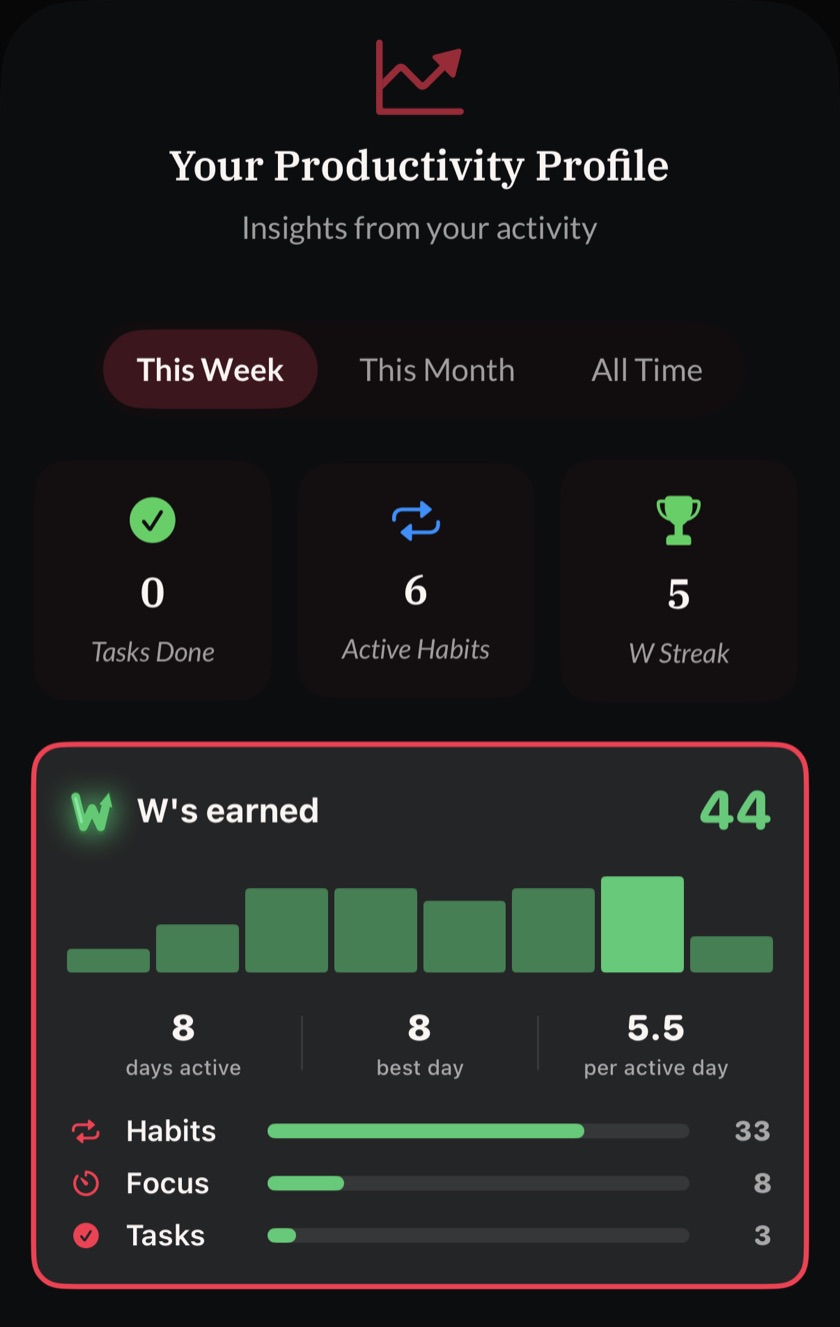
This is where a tool like Vincere can genuinely help. You can assign a task like "send that difficult email" or create a habit like "15 minutes of focused work" and share it with a small crew of friends. There's no public social feed, no pressure to compare yourself to strangers — just a private, shared understanding. When you check off that task and earn a 'W' (a win), your crew sees it. And if you add a photo of the proof (say, a screenshot of the sent email, choosing to share it only with your crew), you earn double the W's. It's a quiet nudge, a shared acknowledgment that you're showing up for yourself.
Vincere's AI coach, Vince, can even help you break down overwhelming tasks and plan your week by conversation, turning vague goals into actionable steps, easing the burden that often leads to feeling lazy. And when you just need to focus for those crucial 5 or 15 minutes, the built-in focus timer can provide that structure.
When overwhelm makes "lazy" the only option, let Vince, your AI coach, help break down big goals into tiny, achievable steps.
Get Vincere on the App StoreScan withyour iPhone
Beyond Today: Building Momentum
Overcoming "feeling lazy at work" isn't a one-time fix; it's a practice of self-awareness and gentle action. Be kind to yourself. Some days will be harder than others. The goal isn't perfect productivity, but consistent, small movements forward. Each small win, each task checked off, each moment you choose to gently push back against the inertia, builds momentum for the next day, and the next.
When It's More Than Just a Lazy Day
If this feeling of pervasive laziness, weakness, or lack of motivation persists for an extended period, significantly impacts your well-being, or is accompanied by other symptoms like persistent sadness, hopelessness, or changes in sleep or appetite, it's important to consider that it might be more than just a passing mood. In such cases, please reach out to a doctor, therapist, or local crisis line. They can offer professional support and guidance.