 Vincere
You know the feeling. It’s 10 PM, or maybe 2 AM, and you’re still scrolling through social media, watching another episode, or staring blankly at the wall. Meanwhile, that thing—the report due tomorrow, the email you need to send, the workout you promised yourself—hangs heavy in the back of your mind, a growing knot of dread and guilt.
It’s not laziness. You want to do it. You know you should. But a strange, invisible force seems to hold you hostage, paralyzing your good intentions. This isn't just about missing a deadline; it's about the quiet disappointment that settles in when you let yourself down, again. The feeling that you're stuck, watching your own potential slowly slip away.
This is the drag of procrastination, and it’s a feeling almost everyone knows intimately. But it doesn’t have to be your default setting. Learning how to stop procrastinating and get things done isn’t about suddenly becoming a productivity robot; it’s about understanding the emotional roots of your delay and equipping yourself with small, kind, actionable steps to move forward.
Why You Procrastinate (It’s Not What You Think)
Before we dive into solutions, let’s get real about why we delay. It’s rarely about a lack of discipline. More often, procrastination is an emotional regulation strategy, however unhelpful it might be. We push things off because:
- It feels overwhelming: The task seems too big, too complex, or requires too much energy. The sheer scale of it paralyzes us.
- Fear of failure (or success): What if you mess it up? Or, what if you succeed and suddenly have higher expectations placed on you? Both can be equally terrifying.
- Perfectionism: The desire to do it flawlessly can stop you from starting at all. If it can’t be perfect, why even try? This "all-or-nothing" thinking is a major roadblock.
- Lack of clarity: You don't know where to start, or what the actual first step is. The vague nature of the task makes it impossible to grasp.
- It’s boring or unpleasant: Let’s face it, some tasks just aren’t fun. Our brains are wired to seek pleasure and avoid pain, so we naturally gravitate away from the unpleasant.
- ADHD or other neurodivergence: For some, challenges with executive function, working memory, and focus can make starting and sustaining tasks incredibly difficult. If you suspect this might be you, know that there are specialized strategies and support available. (For more on this, you might find our article on Feeling Overwhelmed? How to Be More Productive with ADHD, Starting Today helpful.)
Understanding your personal "why" is the first step. Are you avoiding discomfort, seeking perfection, or simply lost in the fog of a huge project?
Feeling the drag of a task weighing you down? Use Vincere to break it into a tiny "W" today and track your progress with your crew.
Try Vincere free Scan with
your iPhone
How to Stop Procrastinating and Get Things Done: Your Action Plan Today
Forget grand declarations and overnight transformations. The path out of procrastination is paved with tiny, imperfect steps.
1. The Two-Minute Rule: Just Start (Seriously)
This is a game-changer. If a task takes less than two minutes to do, do it now. Don't add it to a list, don't think about it, just execute. This breaks the cycle of small tasks piling up.
For bigger tasks, apply the spirit of the two-minute rule: Make your first step take less than two minutes.
- Instead of: "Write the report."
- Try: "Open the document and type the title."
- Instead of: "Workout."
- Try: "Put on my gym shoes."
- Instead of: "Study for the exam."
- Try: "Open the textbook to chapter one."
The goal is to override the initial resistance. Once you’ve started, even a tiny bit, the inertia shifts.
2. Deconstruct the Monster: Break It Down
That overwhelming feeling? It comes from looking at the whole mountain. Your brain needs a map to the first foothill.
Take your big, scary task and break it into genuinely tiny, manageable pieces. We're talking micro-steps.
- Task: "Clean the garage."
- Breakdown:
- "Clear one shelf."
- "Take out one bag of trash."
- "Sort three items."
Write these micro-tasks down. It makes the "how to stop procrastinating school work" challenge or "how to stop procrastinating on homework" much less daunting when you're just tackling "read one page" or "outline the intro paragraph."
3. Lower the Bar (Drastically): Permission to Be Imperfect
Perfectionism is procrastination’s best friend. Give yourself permission to do a "crappy first draft," a "minimum viable effort," or just enough. The goal isn't excellence right now; it's simply forward motion.
Tell yourself: "I just need to finish this section, even if it’s bad. I can always fix it later." This removes the pressure of having to produce something amazing immediately. Often, once you've started, the quality improves naturally.
4. Create an “Implementation Intention”
This is a fancy term for a simple strategy: Plan exactly when and where you’ll do the task. Don't just say, "I'll work on it later."
- "At 9 AM tomorrow, I will sit at my desk and open the report document."
- "After I finish breakfast, I will put on my workout clothes."
This removes decision-making from the moment, reducing the mental friction of starting. If you struggle with the dreaded delay itself, this is a powerful tactic. (You can find more specific tips on this in our article The Dreaded Delay: How to Stop Yourself From Procrastinating.)
5. Find Your Crew: The Power of Shared Effort
Isolation fuels procrastination. When you’re alone with your tasks, the internal monologue of doubt and dread can become deafening. But when someone else knows your intentions, even gently, it creates a subtle shift.
Sharing your intention, your tiny step, or your progress with a friend or a small group can be incredibly motivating. It creates a gentle accountability, not a demanding one. Knowing that someone will see your effort (or lack thereof) can be the push you need. It turns a solitary struggle into a shared journey.
Embracing Small Wins (and Forgiving the L's)
The biggest trap in trying to stop procrastinating is the "all-or-nothing" mentality. You miss one day, and suddenly you feel like a failure, giving up entirely.
Instead, celebrate the small wins. Did you open the document? That’s a win (a "W"). Did you put on your shoes? Another W. Even if you didn't finish the entire task, recognizing these tiny efforts builds momentum and confidence. And if you miss a day, that's an "L"—a learning moment, not a reason to quit. Just pick it up the next day. This constant starting-over, picking-yourself-up approach is how habits are truly built and how you stop procrastinating for good.
Your Digital Ally in Getting Things Done
This is where a tool like Vincere can genuinely help. It’s designed to transform those overwhelming tasks and good intentions into actionable steps and celebrate your progress.
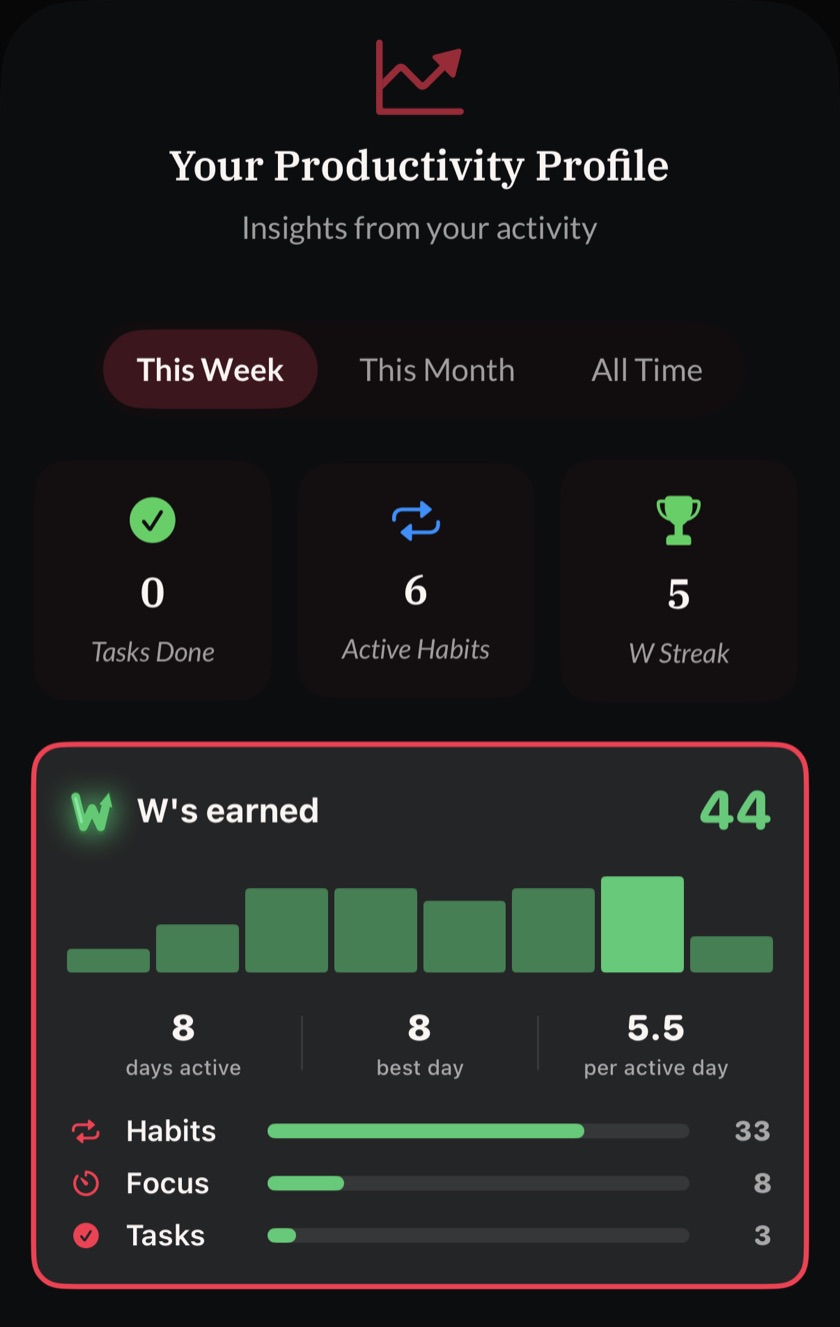
You can break down your daunting projects into individual tasks, set specific due times, and track your progress daily. When you check off a task, you earn a "W" (a win). For an extra boost, you can even add a photo of your proof (e.g., your cleaned shelf, your typed title) to earn double W's. This visual evidence not only reinforces your effort but can be shared privately with friends or a small "habit crew" you choose, allowing them to see your efforts and wins.
Vincere also offers a focused timer, perfect for tackling those micro-tasks without distraction, and an AI coach named Vince who can help you plan your week by conversation and break down big goals into manageable habits and tasks. It's about building a supportive environment, even a digital one, to make starting easier and consistency more attainable. It's not therapy, but it is a structured way to lighten the load and bring a little social support to your personal growth.
Don’t let the drag of delay define your potential. Pick one tiny step from above, commit to it, and take action today. The quiet satisfaction of even a small win is a powerful antidote to procrastination’s heavy grip.
Need a gentle nudge to get started? Share your first small task with a friend on Vincere and celebrate earning your first win together.
Get Vincere on the App StoreScan withyour iPhone
How to stop procrastinating and get motivated: It Starts With Action
Motivation doesn't usually come before action; it often follows it. You don't wait to feel motivated to start; you start, and then motivation often shows up. So, today, pick one thing. Just one. Make it ridiculously small. Take that step. And then, tomorrow, take another.
The journey to stop procrastinating and get things done isn't about grand leaps, but about consistent, tiny steps forward, one "W" at a time.