 Vincere
It is 8:30 on a Sunday night. You sit down on the couch, pull a blanket over your legs, and pick up a book or queue up a movie you have wanted to watch all week.
Your body is on the sofa, but your mind is pacing the floor.
Within four minutes, the hum starts. A quiet, acidic voice behind your ribs begins reciting an unwritten ledger: You didn’t fold the laundry. You didn’t prep lunches. You only answered three of those twelve emails. You said you’d organize the closet this weekend, and look at you. You’ve wasted another entire evening.
You try to read, but you reread the same sentence four times. You look at your phone, put it down, pick it up again. You are not working, but you are certainly not resting. You are stranded in the miserable middle ground of unproductive exhaustion—paralyzed by the thought: I feel guilty for not being productive.
If this sounds familiar, you are not alone, and you are not broken. But you are running an internal program that treats rest like a crime you haven’t yet been caught committing.
Here is how to understand that voice, why it is so loud, and how to stop feeling guilty for not being productive so you can finally live in your downtime.
Why do I feel guilty for not being productive?
To fix the guilt, you have to see where it comes from. Most of us did not wake up one day and decide to equate our human worth with our daily output; we were slowly trained to do so.
1. The midnight reset trap
Many of us treat self-worth like an arcade game where your score resets to zero every midnight. It does not matter that you crushed an intense project on Thursday or helped a friend through a crisis on Friday. By Sunday afternoon, the slate feels blank. If you haven’t generated visible, tangible tokens of effort today, your brain assumes you are falling behind.
2. Work without walls
Generations before us worked jobs with physical endings: a factory whistle blew, an office door locked, a cash register closed. Today, work lives in your pocket. There is no physical threshold telling your nervous system that the hunt is over. Because you could technically answer an email or optimize a spreadsheet at 10:15 PM, your brain treats not doing so as an active choice to be negligent.
3. The trap of "fake rest"
When we feel guilty about stopping, we rarely stop cleanly. Instead of taking an honest two-hour nap or going for a deliberate walk, we hover near our desks. We scroll through social media with half-attention while keeping our laptop open nearby. This is "fake rest": you drain your battery further while convincing yourself that because you didn't enjoy it, you weren't truly slacking off.
Break the guilt loop by logging one small win with a friend today on Vincere.
Try Vincere free Scan with
your iPhone
The specific ache of ADHD guilt for not being productive
If you have a neurodivergent brain, this guilt takes on a distinct, crushing weight.
With ADHD, initiating tasks is not a matter of willpower; it is an issue of dopamine and executive function. You can spend six hours desperately wanting to clean the kitchen, physically staring at the sink, unable to bridge the gap between intention and action.
When you spend an entire afternoon trapped in task paralysis, you haven't been relaxing—you have been in an exhausting mental brawl with yourself. Yet when the day ends, the inner critic writes it off as "laziness."
If this is you, understand that paralysis is a symptom of nervous system overload, not a character flaw. (If this is your daily battle, our guide on how to build habits with ADHD breaks down practical ways to lower that friction without self-hatred).
Feeling guilty for not being productive at work
Work guilt has its own bitter flavor. You sit at your desk at 2:00 PM on a Wednesday. You've hit a wall. You stare at a document for twenty minutes, type one sentence, delete it, and check your team's chat channel to make sure your status bubble still shows green.
You feel like a fraud. You think: Everyone else is heads-down, grinding, making things happen. Why can't I just focus?
Here is the truth: nobody does focused, deep knowledge work for eight continuous hours a day. The human brain manages three to four hours of peak cognitive focus on a good day. The rest is maintenance, processing, and natural mental lulls.
When you fight your natural rhythm instead of accepting a lull, you don't magically become productive; you just become anxious.
4 practical ways to stop the productivity guilt today
Shifting your relationship with rest does not require a week-long silent retreat. It requires practical guardrails you can test tonight.
1. Define "Done" before the day begins
Guilt thrives in ambiguity. If you enter the day with an open-ended goal like "work on the presentation" or "clean the house," your work is never technically complete. You could always do one more slide or scrub one more baseboard.
Before you start, write down the finish line. Not seven things—one to three. * "Write the intro paragraph." * "Wipe down the counter and put the dishes away."
Once those boxes are checked, declare the day closed. If you do anything else, it is a bonus, not an obligation. You cannot feel guilty about missing a target that was never on the board.
2. Give rest an intentional container
Guilt loves passive drifting. When you collapse into scrolling on the rug because you ran out of steam, your brain interprets it as failure.
Flip the script: schedule rest the way you schedule a meeting. Say out loud: "From 3:00 to 4:30 PM, I am going to lie on the bed and listen to music. Doing nothing is the exact task on my agenda."
When rest is an assignment, your inner critic loses its primary weapon. If you find yourself asking whether you're just being lazy, remember that feeling lazy is usually just being tired, scared, or bored.
3. Track small wins, not just unfinished tasks
Our brains have a strong negativity bias: we forget the five tasks we finished by lunch and fixate entirely on the two we postponed until tomorrow.
Keep a "done list" instead of an endless to-do list. At the end of the day, look at what you actually moved forward. A single load of laundry counts. Writing a single difficult email counts. Proof of effort calms the nervous system.
4. Break the isolation loop
Guilt thrives when you are alone in your own head. When your internal monologue is the only voice in the room, it can convince you that you are uniquely behind, uniquely undisciplined, uniquely failing.
Talk to one friend. Tell them: "I feel completely drained today and I'm struggling not to beat myself up for sitting down." Nine times out of ten, they will reply: "I'm sitting on my kitchen floor doing literally nothing right now."
Sanity returns the second your reality is reflected back to you by another human being.
Plan your day cleanly with Vince so you can close your task list and rest without second-guessing.
Get Vincere on the App StoreScan withyour iPhone
Proof over perfection: letting someone else see the win
This is where having a small, trusted circle changes everything. When we built Vincere, we deliberately left out public feeds, vanity metrics, and performative hustle culture.
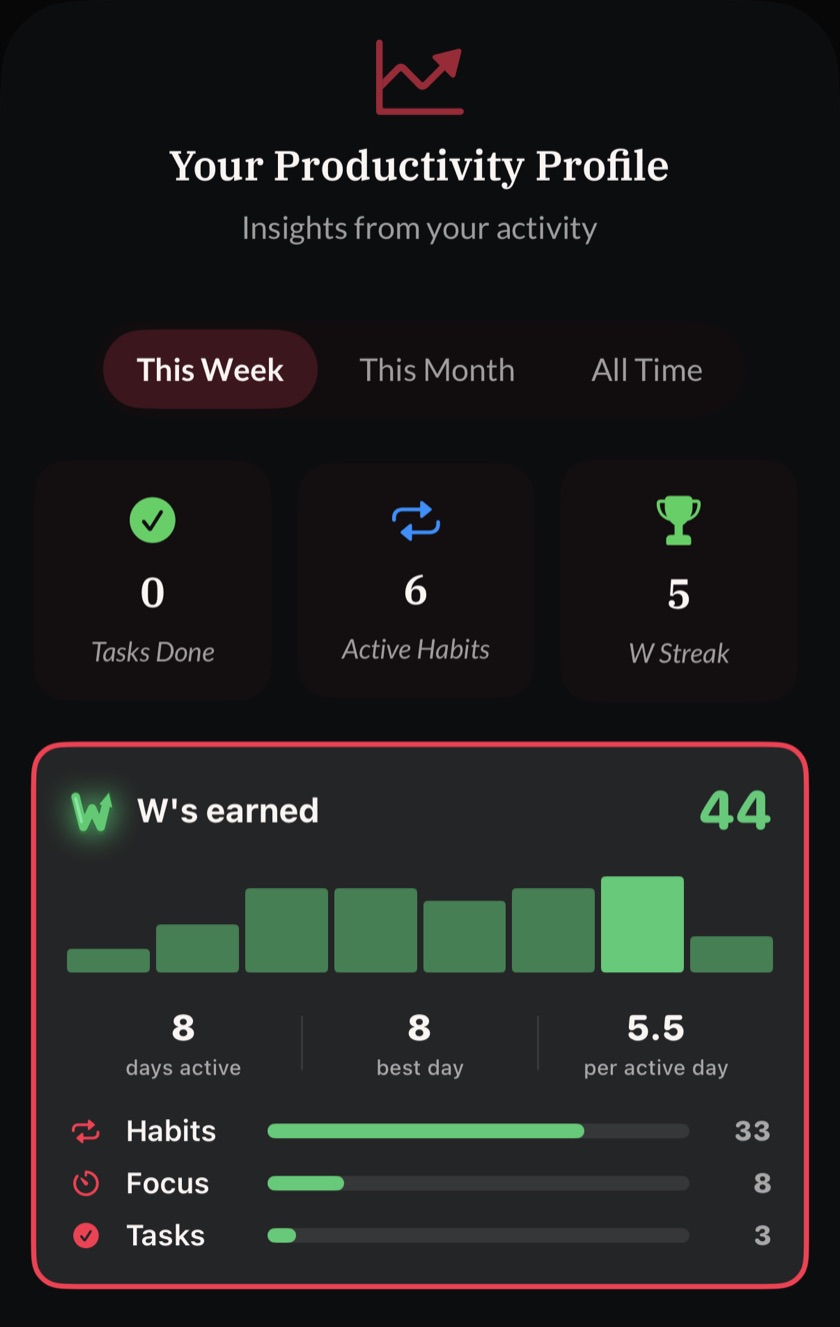
Instead, it is an iPhone app built around shared simplicity. You can share one or two small daily commitments with a friend or a small crew—whether that is drinking a glass of water, reading ten pages, or sitting down for a 25-minute focus session. When you complete it, you earn a "W" (a win), and you can snap a photo to prove you showed up.
There is no public timeline for strangers to judge. Just you and a friend seeing that you did what you said you would do today—and recognizing that once your W is banked, you are free to rest without justifying yourself to anyone.
When the weight runs deeper
There is an everyday guilt born of modern work culture, and then there is a heavier, chronic dread that makes you feel fundamentally defective regardless of what you accomplish.
If your guilt comes bundled with persistent feelings of hopelessness, severe self-loathing, or an inability to enjoy anything in your life, please be gentle with yourself. You do not need a productivity hack; you need care. Speaking with a doctor, a licensed therapist, or reaching out to a local support line can give you a safe, grounded place to unpack that weight.
You do not have to earn your right to exist by burning through your energy reserves.
Tonight's tiny experiment
Tonight, pick one hour. Close your laptop. Set your phone across the room. Tell yourself: "For the next sixty minutes, nothing is missing, nothing is broken, and nothing needs to be produced."
Notice the little spike of panic when you first sit down. Let it sit there. Breathe through it.
You are a living being, not an engine. Your value did not drop when you stopped typing, and it will not rise when you start again tomorrow. Rest is not a reward you have to negotiate for at the end of a long week; it is the ground you stand on.