 Vincere
It is usually 3:14 a.m.
The apartment is silent, save for the dull hum of the refrigerator or a distant siren down on the avenue. You rolled over forty minutes ago intending to sleep, but your thumb betrayed you, unlocking your phone. You scrolled past someone who just sold a company, someone running a marathon at dawn in Lisbon, and someone who renovated an entire cottage with their bare hands.
You locked the screen. The blue glow vanished. And then it arrived—that hollow, sickening drop behind your ribs:
I feel like I'm wasting my life.
The thought does not whisper; it drops like an anvil. It tells you that your twenties are dissolving into spreadsheet tabs and takeout containers. It tells you that everyone else received an instruction manual for adulthood while you were in the hallway daydreaming. It tells you that you are irredeemably behind.
Before you let that spiral dictate the rest of your night, pause. Take a slow breath. What you are experiencing right now is intensely real, but the conclusion your brain is jumping to is almost entirely a lie.
Why Your Brain Turns on You at 3 A.M.
There is a biological reason existential dread strikes in the dead of night. In the early hours of the morning, your body temperature dips to its lowest point, your energy reserves are spent, and the brain’s rational steering wheel—the prefrontal cortex—is essentially offline.
Meanwhile, your emotional threat-detector remains awake, rummaging through your memory banks without adult supervision. In psychology, this triggers severe all-or-nothing thinking. When you are depleted, your brain cannot process nuanced truths like "I had an unproductive Tuesday because my job is draining." Instead, it swings an emotional sledgehammer: "My entire life is a waste."
Add to that the quiet isolation of the night. During the day, conversations, ambient noise, and small errands tether you to reality. In the dark, the echo chamber is sealed. Every unresolved insecurity reverberates until it feels like an undeniable truth.
Break the midnight spiral by picking one simple win for tomorrow with a friend on Vincere.
Try Vincere free Scan with
your iPhone
The Script: "Wasting My 20s" and the Milestone Trap
A huge portion of the terror comes from measuring your real, messy day-to-day life against an invisible script.
If you find yourself searching phrases like "wasting my 20s" (or your 30s), you are likely suffering from the spotlight effect and timeline anxiety. Society gives us a rigid, outdated cultural conveyor belt: graduate at twenty-two, build a skyrocketing career by twenty-six, find a life partner by twenty-eight, buy property by thirty.
When your actual life looks like shared rent, side hustles that fizzled out, and spending Sunday evening watching YouTube on the sofa, you feel broken. You are comparing your messy, unedited behind-the-scenes footage to the crisp highlight reels of others. We wrote about this exact trap in our piece on feeling behind in life, and the remedy starts with noticing that the benchmark itself was manufactured.
Your life is not a race track where other cars are passing you. It is an unmapped forest. You are not falling behind; you are simply existing in the middle of a chapter that feels quiet and unresolved.
Separating Real Regret from Ambient Noise
Not every anxious pang should be dismissed, however. If you are feeling like you're wasting your life, your mind is waving a red flag. The trick is figuring out whether that flag is warning you about a real fire or just flapping in the wind.
To find your way forward, you have to separate the noise from the signal:
- The Noise is loud, vague, and theatrical. It sounds like: "I should be richer," "I haven't left my mark on the world," "I am not exceptional," or "I need to change everything by Monday." Noise creates panic, paralysis, and shame. It never tells you what to do next; it only tells you that whatever you do will not be enough.
- The Signal (Real Regret) is quiet, specific, and surprisingly humble. It rarely asks for global dominance. Real regret sounds like: "I haven't picked up my guitar in four months and my hands miss it." Or: "I scroll for two hours after dinner because I'm lonely." Or: "I haven't called my brother back."
Noise demands a radical reinvention you will abandon by Thursday. Signal points toward a small value you have temporarily neglected.
Listen only to the signal. Let the noise blow away.
How to Stop Wasting Time (Without Overhauling Everything)
When people ask how to stop wasting time, their instinct is usually violent: download six productivity apps, wake up at 5:00 a.m., drink cold-pressed celery juice, and work twelve hours straight.
This is manic self-improvement, and it almost always leads to a deeper crash. When you fail to maintain an impossible standard, the inner critic returns with doubled vengeance: See? You can’t even stick to a morning routine. You really are hopeless.
If you want to break out of paralysis, you do not need an overhaul. You need the physics of one tiny move. We explored how momentum actually works in our guide to feeling stuck in life: action produces clarity, not the other way around.
You do not need to figure out your grand five-year purpose tonight. You just need to claim one meaningful win this week.
Pick One Low-Friction, High-Signal Move
What is one tiny thing that connects you back to your self-respect? Choose something absurdly small:
- A 15-minute unplugged walk around the block before lunch tomorrow—no podcasts, no notifications.
- Writing three sentences in a notebook about an idea you genuinely care about.
- Washing the pan sitting in the sink and clearing your kitchen counter so waking up feels 5% lighter.
- Sending one honest text to a friend: "Hey, I’ve felt a bit disconnected lately. Want to grab a quick coffee this weekend?"
None of these will resolve your existential career doubts. But they do something far more vital: they break the spell of helplessness. They prove that you are an active participant in your own life today.
Turn off the noise, set a 25-minute focus timer, and do one quiet thing that belongs to you.
Get Vincere on the App StoreScan withyour iPhone
Why Doing It Alone Keeps You Trapped
Existential guilt thrives in solitude. When you keep your struggles locked inside your head, you assume everyone else is gliding through life with effortless grace while you stumble from task to task.
Shame shrinks the second another human being witnesses your effort. You do not need an audience of strangers clapping on an algorithm-driven social feed; you just need one or two trusted people who notice that you tried.
This is precisely why we created Vincere. It is an iPhone app built around a small habit crew rather than a noisy public feed. You don’t blast your life to the internet; you pick one or two friends—or just check in with Vince, an AI coach that helps you plan your week without lecturing you.
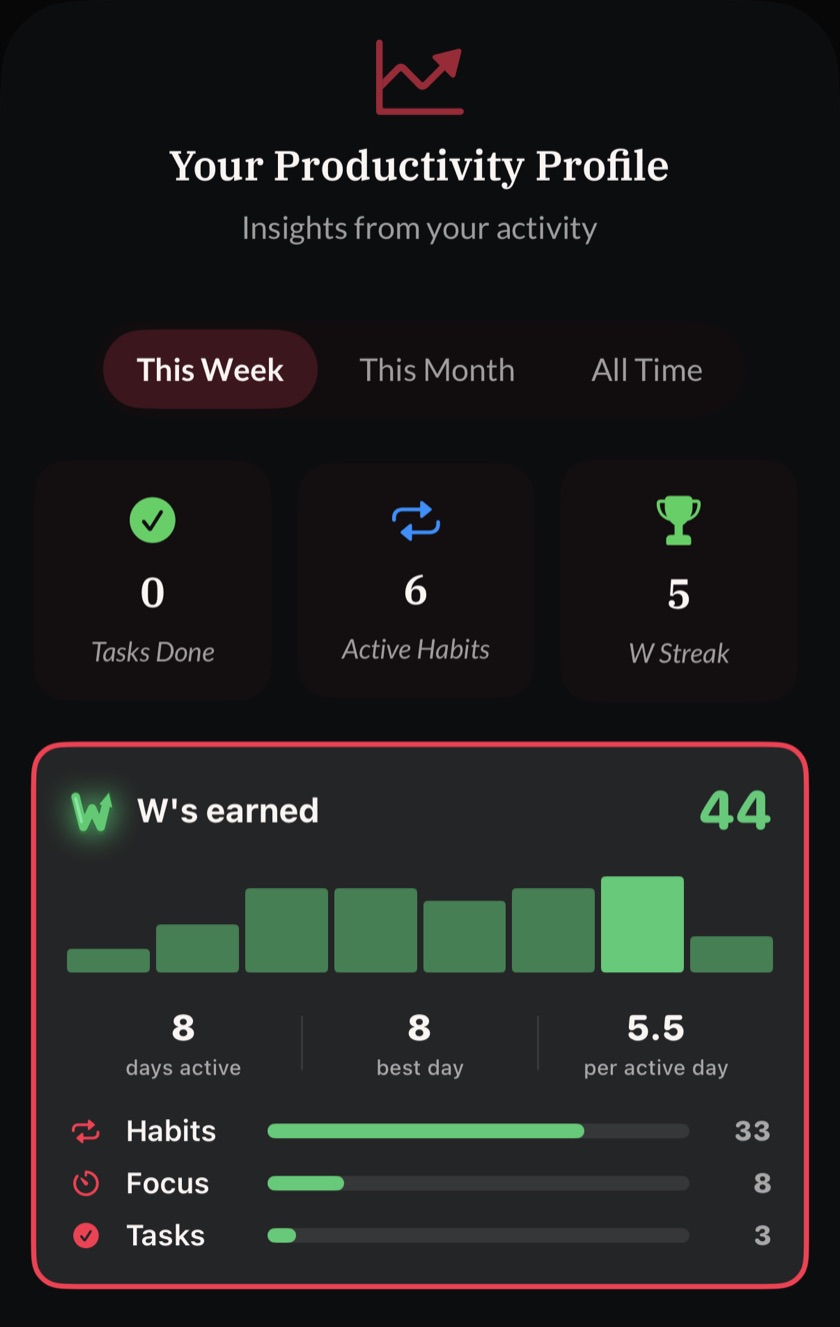
When you do that one meaningful thing—whether it's sitting at your desk for a 25-minute focus session or getting outside for a run—you check it off, snap a quick photo proof for your crew, and earn a "W." Seeing a friend log their own small win makes your days feel shared rather than squandered.
(Note: If the heaviness you feel runs deeper than late-night restlessness—if it feels like an inescapable fog, severe depression, or hopelessness that lingers for weeks—please know you don't have to navigate that by yourself. Speaking with a doctor, a licensed therapist, or reaching out to a local crisis support line is the bravest, most grounding step you can take.)
Tomorrow Is Just a Wednesday
Look out the window. The sky will begin to lighten soon.
You do not have to fix your entire trajectory before dawn. You do not have to prove your worth to your twenties, to your parents, or to your algorithm.
Tomorrow is just a day. When your feet hit the floor, drink a glass of water, step out into the daylight, and do one small, honest thing that belongs to you. That is how a life is built: not in a grand, sweeping epiphany, but one quiet win at a time.