 Vincere
You’re staring at the half-filled journal on your desk, or the forgotten guitar in the corner. Perhaps it’s the workout clothes still folded from yesterday, or the language app icon you just scrolled past again. Another brilliant idea, another burst of enthusiasm, now fading like a distant memory.
It’s that familiar, sinking feeling. The one that whispers: Why can't I stick to anything?
This question isn't just about habits or productivity; it's about a quiet ache of disappointment. It’s the feeling of letting yourself down, again, and the fear that maybe this is just who you are. You try, you start, you get excited, and then… you stop. The cycle repeats, leaving you exhausted and wondering if you're somehow broken.
The Echo Chamber of "Why Can't I Stick To Anything?"
This feeling isn't a sign of failure. It's a common human experience, magnified by an inner critic that loves to replay our past "quits." You're not alone in feeling this way; countless people wonder, "why can I never stick to anything?" or "why can I not stick to anything?"
You're Not Broken: The Brain's Design for Novelty
Our brains are wired for novelty. New experiences, new ideas, new projects – they all trigger a wonderful rush of dopamine, making us feel excited and motivated. This is fantastic for exploration and learning, but less so for the slow, consistent grind of habit building. When the novelty wears off, so often does our initial burst of energy. This isn't a personal flaw; it's how our brains often work. For some, like those with ADHD, this craving for novelty and difficulty with sustained focus can be even more pronounced, making the act of sticking to routines feel like an uphill battle against their own neurobiology. But regardless of your specific wiring, understanding this preference for "new" can help you adapt your strategies.
The "All-or-Nothing" Trap and Your Inner Critic
One of the biggest culprits in the "why can't I stick to anything" dilemma is the "all-or-nothing" mindset. You tell yourself you need to go to the gym for an hour, every single day, or it doesn't count. You miss one day, and suddenly the whole thing feels ruined. The inner critic swoops in, piling on the guilt and shame.
"See? You never stick to anything."
"What's the point? You just messed it up anyway."
This destructive thinking makes it impossible to recover from small missteps. Instead of seeing a missed day as just one day, we see it as proof of our inherent inability to be consistent. This is a cruel trick our minds play on us. If you've ever felt the crushing weight of a broken streak, you might find solace in reading our article: Ashamed After Breaking a Streak? Why One Miss Doesn't Ruin Everything.
Tired of starting over alone? Invite a friend to your habit crew on Vincere and see who shows up today.
Try Vincere free Scan with
your iPhone
How to Finally Build What Lasts: Tiny Steps You Can Take Today
The good news? It’s not about willpower as much as it is about strategy. Here’s how you can shift from a cycle of starting and stopping to building momentum that actually sticks.
1. Start Ridiculously Small
Forget grand gestures. When you're asking "why can't I stick to something?", the answer often lies in trying to do too much, too soon. Instead, aim for the smallest possible action. Want to read more? Don't aim for a chapter; aim for one page. Want to meditate? Start with 60 seconds. Want to exercise? Put on your shoes.
The goal isn't to achieve a big outcome on day one. The goal is to show up. To prove to yourself, repeatedly, that you can initiate the action. Once you start, you'll often find the momentum to do a little more. But even if you don't, you still "won" by showing up.
2. Connect to Your True "Why"
Surface-level goals ("I should exercise") rarely last. Dig deeper. Why do you want to stick to this? Is it to feel more energetic to play with your kids? To have a clear mind for creative work? To build confidence? When you understand the deeper value or emotion driving your desire, you create a far more resilient motivation than simply "because I should." This "why" acts as your anchor when the novelty wears off and the inner critic starts whispering.
3. Build Your Crew: The Power of Shared Effort
Trying to build new habits in isolation can feel incredibly lonely. There’s no one to cheer you on when you show up, and no one to gently remind you when you don’t. This isolation makes it easier to quietly abandon a goal without anyone noticing.
This is where a little bit of kind accountability can be a game-changer. Sharing your intentions with a trusted friend or a small group shifts the dynamic. It’s not about judgment; it’s about mutual support and shared motivation. Just knowing someone else is also working towards their goals, or that they’ll see your progress, can provide that gentle nudge to keep going when you'd otherwise give up. If this resonates, you might appreciate our piece on The Quiet Ache of Lonely Self-Improvement.
4. Expect Imperfection, Plan for Detours
Life happens. You'll get sick, you'll have busy days, you'll simply not feel like it. Instead of letting these moments derail you completely, anticipate them. This is called "implementation intentions." For example: "If I miss my morning workout, then I will do 10 minutes of stretching before bed." Or, "If I feel unmotivated to write, then I will just open the document for 5 minutes."
Planning for the inevitable dip helps you pivot, rather than simply giving up. It's about being prepared, not perfect.
5. Review, Adjust, and Keep Going
When you do "fail" to stick to something, don't just abandon it. See it as data. What happened? Was the goal too big? Was your "why" unclear? Did something specific trigger the break? Learning from these moments helps you adjust your strategy, rather than repeating the same pattern. It’s a process of continuous iteration, not a single pass/fail test.
How Vincere Can Be Your Consistency Crew
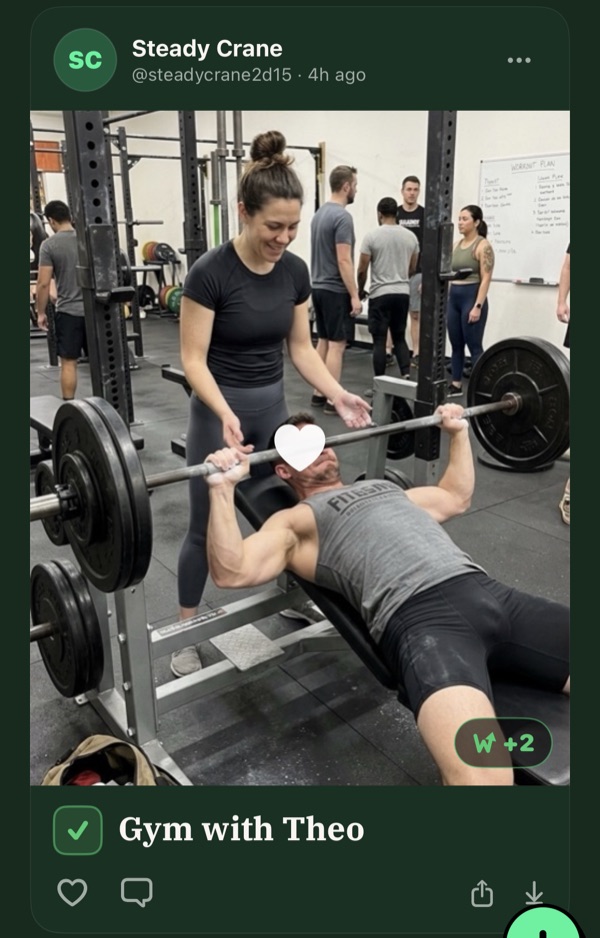
Building consistency can be tough, especially alone. Vincere is a free iPhone app designed to help you build habits with a crew. You can share tasks and habits with friends, and everyone sees who showed up today. This kind of gentle, shared accountability helps combat the isolation of self-improvement, giving you a supportive circle without a public social feed. Friends only see the tasks and habits you choose to share with them, their check-offs, and proof photos you opt to show them.
Whether you're earning W's (wins) for checking off tasks, adding proof photos for extra W's, or using Vince, the AI coach, to plan your week and get morning/evening check-ins, Vincere helps you visualize your progress and keep the momentum going. It's about seeing your streaks, understanding your productivity, and having tools like a focus timer and habit grid to support your journey – all designed to help you finally stick to the things that matter.
What If It Feels Too Heavy?
Sometimes, the feeling of "why can't I stick to anything" runs deeper than habit strategy. If you find yourself struggling with persistent hopelessness, severe lack of motivation, or thoughts that are too heavy to carry alone, please reach out for professional help. A doctor, therapist, or local crisis line can provide the support you need. You don't have to carry this alone.
Break the 'all-or-nothing' cycle. Track your smallest wins and share proof with your crew on Vincere.
Get Vincere on the App StoreScan withyour iPhone
Your Next Small Step
The journey to sticking with things doesn't start with a grand overhaul; it starts with a single, tiny act of defiance against the cycle of disappointment. Choose one small thing you want to cultivate, make it ridiculously easy, and find one person who can be your crew. Show up for that tiny thing today. Even if it's just for two minutes. That's your win.