 Vincere
The kitchen light feels violently bright. Your phone has vibrated three times in two minutes with messages you don’t have the stomach to read. Your collar is itching against your neck, there are fourteen tabs open on your laptop, and the sink is full of dishes you swore you would wash before noon.
You aren't just stressed about your to-do list, and you aren't just tired. You are caught in the crossfire of being overwhelmed and overstimulated at the exact same moment.
Your brain has run out of working memory, and your nervous system has run out of bandwidth. When someone asks you a simple question—even something gentle, like "What do you want for dinner?"—it doesn't register as a choice. It registers as a physical demand. You might snap, or you might stare blankly at the wall, frozen, unable to move a single muscle.
If you are reading this while sitting on the floor or hiding in your car just to escape the noise: take a breath. You are not broken, you are not failing, and you do not need to fix your entire life in the next ten minutes. You just need to bring the room down to a simmer.
Overwhelmed vs. Overstimulated: The Double Squeeze
We often use these two words interchangeably, but they attack your equilibrium from different flanks.
- Overwhelm is cognitive and emotional. It happens when the volume of tasks, decisions, expectations, and emotional demands exceeds your perceived ability to cope. In psychology, it’s an overflow of cognitive load. (If you’ve ever looked for the word for overwhelmed in Spanish, you’ll find agobiado or abrumado—words that literally evoke feeling weighed down, smothered, or suffocated under pressure.)
- Overstimulation is physiological and sensory. It happens when your senses take in more raw data—fluorescent lighting, overlapping podcasts, traffic rumble, notifications, tight waistbands—than your nervous system can filter. Your sympathetic nervous system slips into high gear, flooding your body with cortisol and adrenaline.
When you are only overwhelmed, you can usually sit quietly and draft a list. When you are only overstimulated, you can close your eyes in a quiet room until the static clears.
But when you are both? The sensory noise prevents you from thinking through your problems, and your mountain of responsibilities makes it impossible to relax your body. You enter a state of functional freeze: staring at everything, doing nothing.
When the room feels too loud, step back: pick one tiny micro-habit on Vincere and let today count as a win.
Try Vincere free Scan with
your iPhone
Step 1: Kill the Sensory Inputs First (The Body Downshift)
You cannot think your way out of a sensory traffic jam. Trying to organize your thoughts while your nervous system is screaming is like trying to balance a checkbook inside a siren.
Before you write a list, reply to a text, or solve a problem, you must lower the physical decibels of your environment:
- Cut the lighting. Overhead LEDs and fluorescent bulbs demand constant, micro-level visual processing from your brain. Turn them off. Switch to a dim lamp, pull the blinds, or wear sunglasses indoors for twenty minutes if you cannot control the room.
- Remove physical restriction. Kick off tight shoes, unbutton stiff waistbands, take off scratchy sweaters. Physical constriction sends subtle, persistent danger cues to an already hyper-vigilant nervous system.
- Change the auditory frequency. Put on noise-canceling headphones without music, or play brown noise (a deeper, lower-frequency sound than white noise that mimics a heavy rainfall or distant waterfall). It masks jarring, unpredictable household sounds.
- Drop your shoulders away from your ears. When we are flooded, our shoulders creep up toward our jaw. Drop them intentionally. Let your belly go soft.
Give your sensory system five uninterrupted minutes of low-input stillness before you attempt to deal with your mind.
Step 2: Clear the Mental Buffer (Externalize Everything)
Once your sensory alarms stop blaring, you are left with the mental swarm.
When you feel crushed, your working memory tries to juggle five different deadlines, an unmade dentist appointment, an awkward text conversation, and tomorrow’s groceries simultaneously. The brain is terrible at holding items in an active queue; it treats every unaddressed thought as an urgent threat.
Grab a scrap piece of paper and a dull pen. Do not open an app yet, and do not make a pristine schedule. Write down every single floating obligation in a chaotic, unformatted brain dump:
- Return Sarah's call
- Trash needs to go out
- Client deck is due Friday
- Buy toothpaste
- Reply to landlord
Do not organize them. The goal is simple extraction. By moving these thoughts from your internal working memory onto paper, your brain finally receives the signal that it can stop holding them upright.
Step 3: Draw a "One-Thing Perimeter"
Look at your scribbled paper. Right now, your inner critic is probably telling you that you need to knock out seven of these items to prove you aren't lazy.
Resist that impulse. That is how burnout from self-improvement sneaks back in. When your nervous system is fried, ambition is your enemy; containment is your friend.
Pick exactly one item from the list. Not the most important one. Not the biggest one. Pick the smallest, least threatening action that leaves a visible footprint.
- Take the mugs off your desk and put them in the sink.
- Send a three-word text: "Got it, tomorrow!"
- Wipe down the kitchen counter.
Set a physical perimeter around that single task. For the next ten minutes, the rest of your life does not exist. The client deck does not exist, the unopened mail does not exist, the messy closet does not exist. You are simply a person rinsing a mug. Completing one microscopic physical action proves to your brain that the world is still navigable.
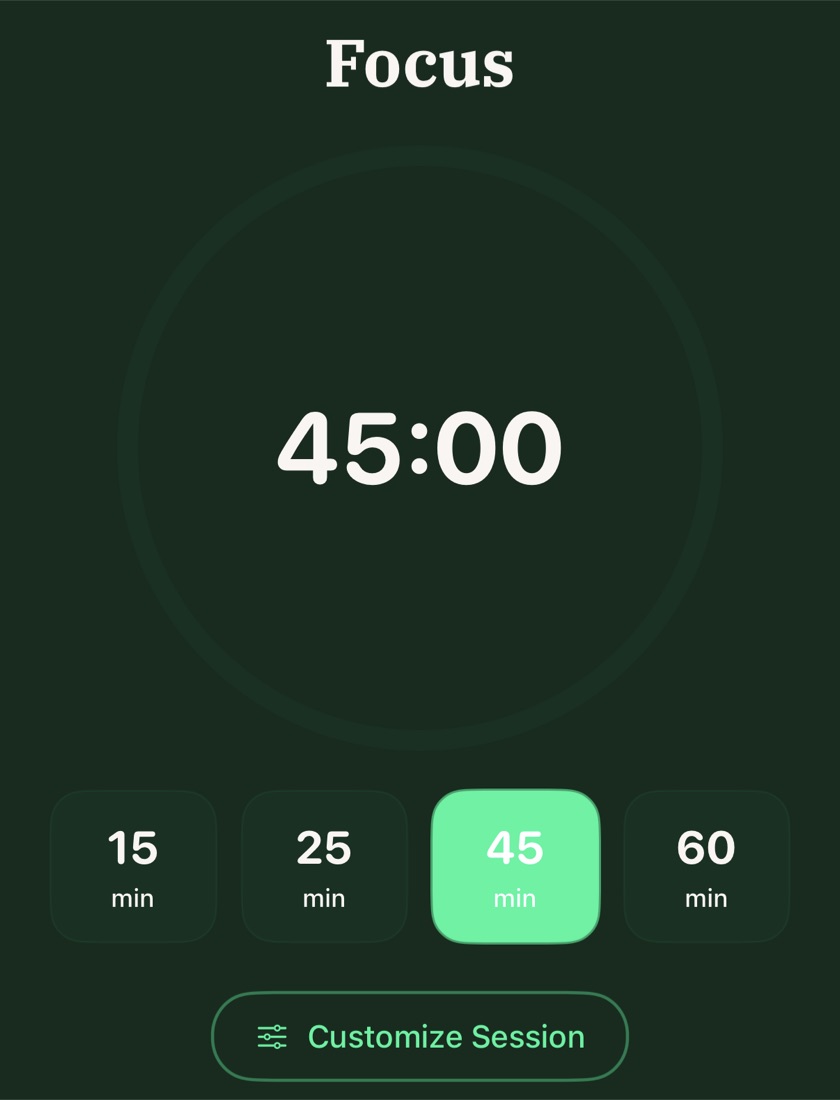
Drown out the digital static. Use Vincere’s built-in focus timer to work on just one quiet task for fifteen calm minutes.
Get Vincere on the App StoreScan withyour iPhone
Step 4: Break the Isolation of Overwhelm
Overwhelm thrives in solitary confinement. When you sit alone in a messy room or stare by yourself at a glowing monitor, your struggles feel monstrous, shameful, and uniquely yours. You convince yourself that everyone else is managing their jobs, their children, their workouts, and their text threads with effortless grace, while you are coming undone over an email.
They aren't. Everyone hits the sensory wall; most people just hide it behind closed doors.
One of the fastest ways to soothe an overloaded nervous system is co-regulation—letting another person’s presence anchor you. You don't need a deep, two-hour therapy session. You just need someone to see a tiny piece of your reality.
Text a trusted friend: "My brain is completely overloaded today. I’m going to spend 15 minutes folding laundry and drinking a glass of water, then I’m lying down."
This is also why we built Vincere. When you are drowning in digital noise, you don't need another noisy social feed full of strangers showing off their perfect morning routines. Vincere is a quiet habit and task app designed around small circles: you can share a single daily habit with one or two friends, check it off, and attach a simple proof photo. No comments section, no public feed, no performative metrics—just a quiet nod from someone you care about that says, I see you showed up today, even when it was hard.
(Note: While sensory overwhelm and mental fatigue are common parts of being human, persistent feelings of paralyzing dread, deep despair, or chronic shutdown deserve deeper care. Talking to a physician, licensed therapist, or reaching out to a local support hotline can give you the professional floor you need to stand on.)
Give Yourself Permission to Do Less Today
You do not need to finish your week today. You do not need to solve your five-year plan before dinner.
Turn off the big light. Put your phone face-down on a shelf across the room. Pick one single, tiny thing to take care of, or simply sit on the couch with a glass of water and let the buzzing in your temples slow down.
Surviving an overstimulated afternoon is not a lost day. It is your body asking you, in the only language it knows, to put the heavy things down. Listen to it.