 Vincere
You’re staring at the screen, three browser tabs open for "urgent" tasks, your phone buzzing with notifications, and a half-written email blinking accusingly. You switch between them, convinced you're "multitasking," but an hour later, all you have is a growing headache and three half-finished items. The initial surge of energy has evaporated, replaced by a quiet frustration, a feeling of being busy but profoundly ineffective. It’s like trying to catch water with a sieve – all effort, no capture. You want to dig deep into one thing, to feel the satisfying click of completion, but the world (and your own mind) seems to conspire against it.
This feeling of being scattered, of always being on, yet never truly on any one task, is exhausting. It feeds the dread that you're falling behind, that everyone else has some secret superpower of concentration you lack. You feel like you're wasting valuable time, bouncing between tabs and thoughts, unable to anchor your attention.
Why We Struggle to Focus on One Thing at a Time
The problem isn't usually a lack of willpower; it's a battle against an environment designed for distraction and a brain that loves novelty.
- The Myth of Multitasking: Our brains don't actually multitask. They task-switch, rapidly jumping between activities. Each switch costs energy, reduces comprehension, and increases errors. You might feel busy, but you're rarely effective.
- Digital Overload: Notifications, endless feeds, the siren call of new emails – our devices are built to constantly pull our attention. It’s hard to focus on GTA 6 when you're also trying to file your taxes. And it's even harder to file your taxes when you keep thinking about GTA 6.
- Fear of Missing Out (FOMO) / Fear of Missing Out on Productivity (FOMOP): We worry that if we commit to one task, we'll miss an urgent message or a "better" opportunity. Or, we feel guilty ignoring the other twenty items on our to-do list.
- Lack of Clarity: When we don't know exactly what we need to do, or why, our brains resist settling into deep work. They'd rather browse.
The good news? You can train your focus. It's a muscle that strengthens with practice, not a fixed trait. And you don't need to overhaul your entire life to start.
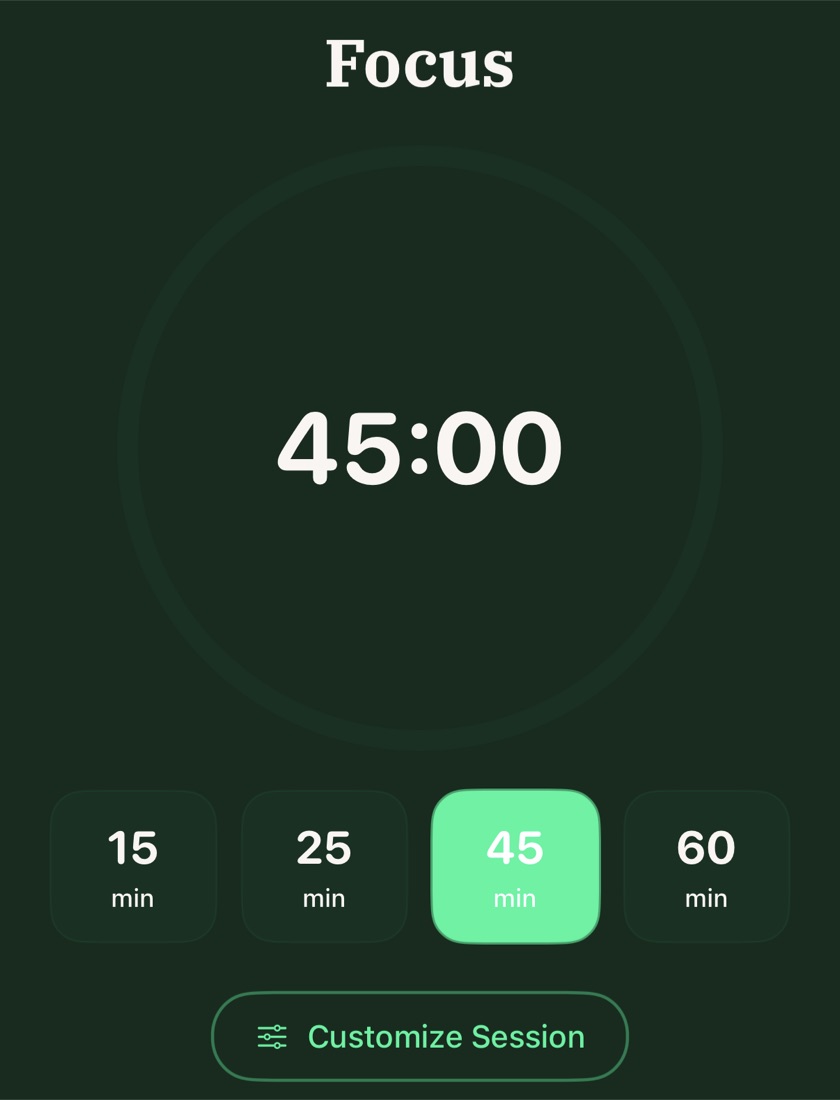
Feeling scattered? Pick your "one thing" and use Vincere's Focus Timer to block out distractions and get it done, starting today.
Try Vincere free Scan with
your iPhone
Your Action Plan: How to Focus on One Thing, Today
Let's break down the "how to focus" puzzle into small, actionable pieces you can implement within the next hour.
Step 1: Pick Your "One Thing" (The MIT)
This is the most crucial step. If you don't choose, everything else chooses for you.
- Identify Your Most Important Task (MIT): Look at your to-do list. What is the single task that, if completed today, would make you feel the most accomplished, or relieve the most stress? It might not be the easiest, but it's the one that moves the needle.
- Example: Instead of "Work on report," try "Write introduction for quarterly report (500 words)."
- Write It Down, Big and Bold: Physically writing it down helps solidify your intention. Put it on a sticky note, a whiteboard, or in your digital task manager. Make it visible. This is your target. All other tasks are secondary.
Step 2: Build Your Fortress of Focus (Even a Mini One)
Once you know what to focus on, create an environment that supports that focus.
- Digital De-clutter (The Mute Button is Your Friend):
- Silence Notifications: Turn off ALL non-essential notifications on your phone and computer for your dedicated focus block. Go into "Do Not Disturb" mode.
- Close Unrelated Tabs: Seriously. If it's not directly related to your MIT, close it. Even a tempting Reddit thread or a news article acts as a mental distraction, pulling energy away from your main task.
- Consider an App Blocker: If certain apps are habitual attention-grabbers (looking at you, social media), use a tool to block them during your focus time. It’s like having a bouncer for your brain.
- Physical Space Tidy-Up (Micro-Level): You don't need a perfectly minimalist office. Just clear the immediate area around your workspace. Remove anything that could catch your eye or hand – stray papers, coffee mugs, that book you've been meaning to read. A clear desk often leads to a clearer mind.
Step 3: Engage with Intention (and a Timer)
Now, it's time to dive in. But not just "start working." Start strategically.
- The 25-Minute Power Sprint (Pomodoro Technique): Set a timer for 25 minutes. Commit to working only on your MIT for that entire duration. No checking emails, no grabbing snacks, no switching tabs. Just the MIT. When the timer goes off, take a short, purposeful break (5 minutes) – stretch, grab water, look out the window. Then repeat.
- Why this works: It breaks overwhelming tasks into manageable chunks and creates a clear "on" and "off" switch for your brain. For those with ADHD, this structured approach can be a game-changer for initiating and sustaining attention. (Want to dive deeper? Check out our article: ADHD Focus Fix: The Pomodoro Technique Life-Hack).
- Mindful Distraction Handling: When a distracting thought or urge arises (and it will!), don't scold yourself. Simply acknowledge it. "Okay, brain, I hear you want to check the news. I'm going to finish this 25 minutes first, then I can." If it's something you genuinely need to remember, jot it down on a "later" list beside you, then return to your MIT. This externalizes the thought, freeing your mind.
Step 4: The Social Side of Sticking With It
Focus doesn't have to be a lonely endeavor. Sometimes, the quiet awareness of another person can make all the difference.
- External Accountability: Telling someone your MIT for the day, or even just sharing your progress, can be a powerful motivator. Knowing someone might see your effort (or lack thereof) helps you stay committed.
- Working with a "Crew": Imagine you’ve committed to finishing a challenging report. What if you could share that specific task with a friend or colleague, not just a vague goal, but the actual task? They don't do it for you, but they see your check-off, your effort. This low-pressure, high-impact visibility creates a gentle nudge to follow through. It makes the abstract goal of "focusing" feel concrete and supported. It’s like having a silent co-pilot for your attention.
For many, especially those who struggle with executive function (a common challenge for individuals with ADHD), externalizing these processes – planning, timing, accountability – can provide the necessary structure to sustain focus. (If you resonate with this, our guide on How to Be More Productive with ADHD, Starting Today offers even more tailored strategies).
Step 5: Prioritize Your Focus (on Yourself)
"How to focus on yourself" isn't about ignoring the world; it's about deliberately choosing what deserves your precious attention. When you consistently choose to focus on one important task, you are investing in yourself – your goals, your peace of mind, your sense of accomplishment. You're saying "no" to the noise and "yes" to your own growth. This act of choosing and committing is a powerful form of self-care.
When you consistently finish one thing, you build momentum. That feeling of satisfaction, of earning a "W" for a completed task, is incredibly reinforcing. It trains your brain to associate focus with reward, making it easier to start the next time.
Today, pick just one thing. Block out the world for 25 minutes. Do it. Feel the quiet power of completion. You might be surprised at what you can achieve when you stop trying to do everything and simply choose to do one thing well.