 Vincere
It's 2 PM. You’ve been at your desk for hours, coffee cup long empty, browser tabs open to everything but the task you should be doing. Maybe you’re scrolling through social media, maybe you’re just staring blankly at your monitor, a knot of quiet frustration tightening in your stomach. The to-do list mocks you from its perch on your screen, each item glowing with unspoken judgment. You feel the drag of knowing you’re falling behind, even as you can’t quite summon the will to start.
This isn’t just "laziness." This is the unique, often isolating struggle of trying to figure out how to be more productive when working from home. The lines between work and life blur into a confusing smudge. The siren song of household chores, the fridge, or just "one more quick check" of your phone becomes deafening. You feel a quiet shame, knowing you have the flexibility you once craved, but can't quite make it work. Your inner critic whispers, “You should be doing more. Look at everyone else.”
You’re not alone in this feeling. Many of us navigate this daily dance with distraction and self-doubt. The good news? You don't need a complete overhaul or a perfectly zen home office. You need small, practical life-hacks that help you build momentum and ease that internal pressure.
Why Working From Home Feels So Different (and Harder)
When you work from home, you lose the natural cues and boundaries of an office environment. There’s no commute to mentally switch gears, no colleagues' presence creating a shared sense of purpose, and no boss physically looking over your shoulder. This means the entire burden of structure, focus, and motivation falls squarely on you.
This is why "just trying harder" often backfires. It’s not about willpower; it’s about creating systems that support your focus, rather than leaving you vulnerable to every distraction.
Feeling the drag of endless distractions? Try a focus timer or share a small task with a friend today using Vincere to build momentum.
Try Vincere free Scan with
your iPhone
Life-Hacks to Reclaim Your Focus and Feel More Productive
Let's break down some specific, actionable steps you can take today to chip away at that feeling of overwhelm and start building real momentum.
1. The Power of the "Tiny Start"
Often, the hardest part of any task is simply starting. We dread the mountain, so we never take the first step. The "tiny start" method is your secret weapon. Instead of committing to "write the report," commit to "open the document and write one sentence." Instead of "clean the house," commit to "pick up five things."
How it works today: Pick one task you've been dreading. Identify the absolute smallest, most trivial step you can take towards it. Set a timer for 5 minutes and only do that tiny step. More often than not, once you start, the inertia breaks, and you'll find yourself flowing into the next step.
2. Designate Your "Work Zone" (Even If It's a Kitchen Counter)
One of the biggest culprits for blurred boundaries at home is the lack of a dedicated workspace. Your brain needs clear signals for when it's "work mode" versus "home mode."
You don't need a fancy office. It could be: * A specific corner of your kitchen table. * A designated armchair. * Even just turning your chair to face a blank wall rather than a window when you need to focus.
How it works today: Before you start work, tidy your chosen "work zone." Even just clearing away breakfast dishes or old mail helps. When you "clock out," put away your laptop or work materials. This physical act helps your brain switch off, reducing the lingering feeling of "I should still be working."
3. Embrace Structured Focus Sessions (Your Brain Craves It)
Open-ended work time is a recipe for distraction. Your brain thrives on structure. This is where techniques like the Pomodoro Method shine. Work in focused bursts, followed by short breaks.
For example: * 25 minutes of focused work: Absolutely no distractions. * 5-minute break: Get up, stretch, grab water, look out the window. * Repeat 3-4 times, then take a longer break (20-30 minutes).
How it works today: Download a simple focus timer app or use a kitchen timer. Block out 25 minutes for one specific task. See what you can accomplish. You might be surprised. If 25 feels too long, start with 15 minutes. The key is consistency.
4. Tame the Digital Beast (Your Phone)
Let's be honest: your phone is probably your biggest saboteur. Notifications pull you out of flow, and "just checking" quickly becomes 20 minutes of endless scrolling.
How it works today: * Physical distance: During your focus sessions, place your phone in another room or far from your desk. * Notification cleanse: Turn off all non-essential notifications for work apps and social media. Batch check them at specific times. * App Blocker: If you're on an iPhone, tools like Screen Time (or specific App Blocker features in productivity apps) can temporarily disable distracting apps during your work hours. This creates a helpful external barrier when your willpower is low.
5. Leverage the Power of Accountability (Even Small Doses)
When working from home, the lack of external accountability can make it easy to drift. Humans are wired for connection and a little gentle peer pressure. Sharing your intentions can be a huge motivator.
This doesn't mean airing your entire workday on social media. It means finding a trusted friend, family member, or colleague and simply sharing one or two specific tasks you plan to accomplish today. A quick text like, "Hey, my goal today is to finish the client proposal," can create just enough gentle obligation to help you follow through.
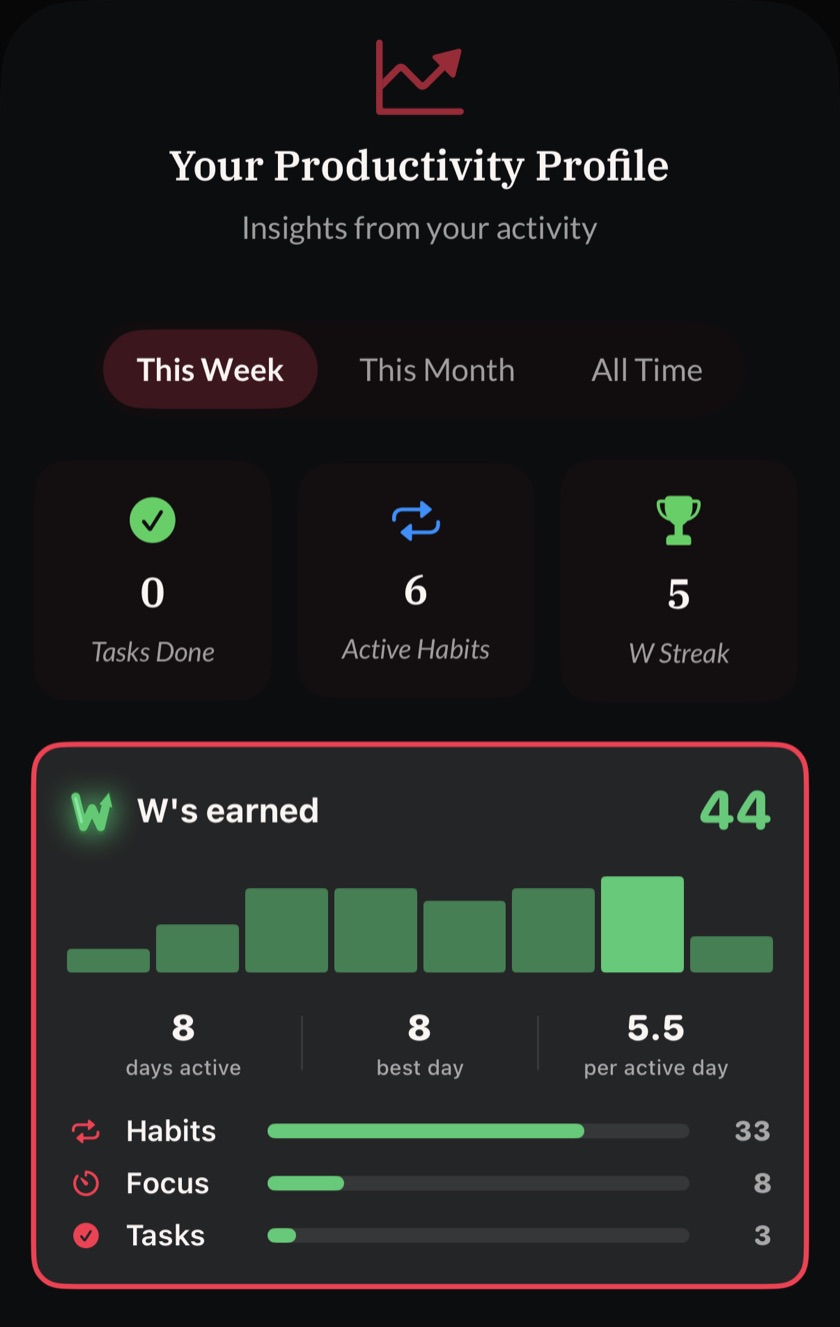
Knowing someone else sees your effort, even if it's just a check-mark, can transform your motivation. This is where tools designed for shared progress come in. With an app like Vincere, you can share a specific task or habit with a friend or a "crew." You both see who showed up and checked off their task for the day, earning a 'W' (win). This quiet, shared accountability can be a powerful antidote to the isolation of working from home.
6. Start Your Day with Intention (Even If You're Dreading It)
The morning sets the tone. If you roll out of bed and immediately dive into emails, you're reacting, not creating. A structured morning routine can significantly impact your productivity. It doesn't need to be elaborate.
How it works today: Pick one small, non-work related activity to do before you open your laptop. This could be: * Drinking a glass of water. * Stretching for 5 minutes. * Walking around the block. * Meditating for 2 minutes.
This small victory helps you feel in control of your day from the outset. For more ideas, check out our article on How to Be More Productive in the Morning.
7. Be Kind to Your Brain (Especially if It's Neurodivergent)
If you find that traditional productivity advice just doesn't stick, or you experience significant challenges with focus, executive function, or task initiation, you might be dealing with something more. Conditions like ADHD, for instance, present unique hurdles for productivity, especially in unstructured environments like home.
It's crucial to practice self-compassion and explore strategies tailored to how your brain works. If you suspect ADHD might be at play, or you're just feeling consistently overwhelmed, remember that specialized tools and approaches exist. We’ve covered some specific strategies in our guide: How to Be More Productive with ADHD, Starting Today.
Ready to transform overwhelm into real progress? Let Vince, your AI coach, help plan your week and create actionable tasks for you.
Get Vincere on the App StoreScan withyour iPhone
Your Action Plan for Today
Don't try to implement all of these at once. That's a recipe for overwhelm and giving up. Pick just one of these life-hacks and try it today.
Maybe it's the "tiny start" for that big project. Maybe it's putting your phone in another room for 25 minutes. Maybe it's telling a friend about one task you'll complete.
The goal isn't perfection; it's progress. It's about slowly chipping away at the feeling of being stuck and replacing it with the quiet satisfaction of small wins. You're building a new muscle, one intentional action at a time. And every win, no matter how small, counts.